


Steinbeck, me & the pursuit of 'true nonfiction'
Joel Miller interviewed me this summer about 'Dogging Steinbeck,' my 'expose' of the fictions in Steinbeck's 'Travels with Charley,' and the slippery verities of writing nonfiction.

This substack is about how I came to write my 2012 book ‘Dogging Steinbeck’ and what I learned about the underlying untruthfulness of John Steinbeck’s best-selling road book ‘Travels with Charley’. It appeared in MILLER’S BOOK REVIEW 📚 on July 10, 2024. Joel Miller wrote the questions, emailed them to me and I tried to write answers that made sense.
— Bill Steigerwald
Challenging Experts: A Lone Journalist Confronts John Steinbeck
A Conversation with Bill Steigerwald, Author of ‘Dogging Steinbeck’
Jul 10, 2024
Bill Steigerwald is a veteran journalist whose career spans nearly four decades, working for the Los Angeles Times in the eighties, the Pittsburgh Post-Gazette in the nineties, and the Pittsburgh Tribune-Review in the aughts. I worked with him briefly at the turn of the century and was delighted to reconnect with him recently here on Substack, where he shares from the deep archive of his work.
As a former syndicated columnist, Steigerwald’s work has appeared in newspapers across the country. He’s also written for such magazines as Reason, Men’s Journal, Family Circle, and Penthouse and has interviewed such newsmakers as George McGovern, Jane Jacobs, Tommy Lasorda, Milton Friedman, and Timothy Leary.
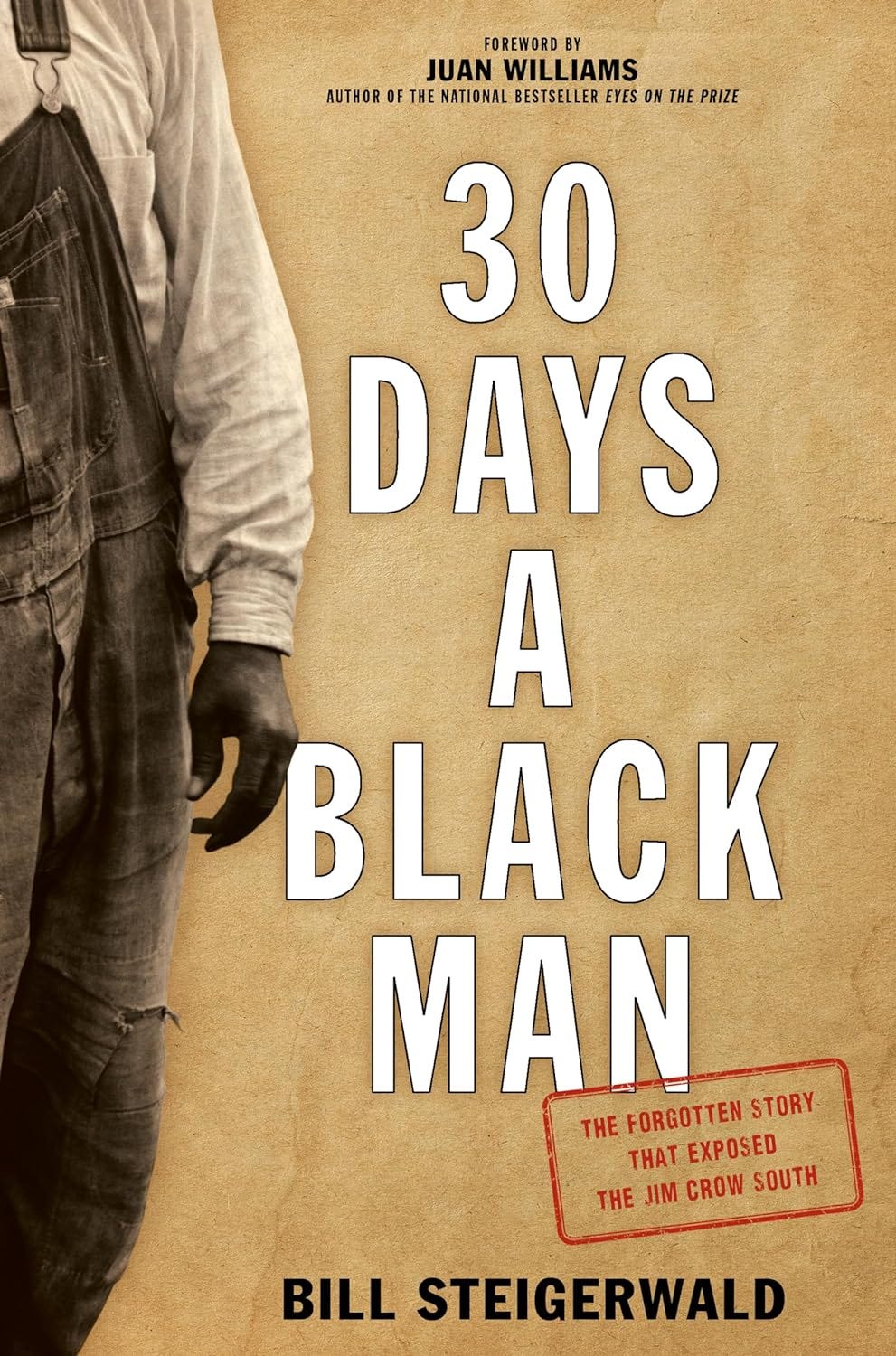
After retiring from daily journalism fifteen years ago, Steigerwald began writing books. In 2017, he published 30 Days a Black Man: The Forgotten Story That Exposed the Jim Crow South, which relates Pittsburgh Post-Gazette reporter Ray Sprigle’s 1948 undercover reporting in the Deep South. Kirkus praised it as “a fascinating account of an anti-Jim Crow muckraking adventure.”
As great as that book is, however, I wanted to ask Steigerwald about John Steinbeck’s beloved bestselling 1962 memoir Travels with Charley—a book that, as I alluded to in my review, stretches the definition of nonfiction. Steigerwald traveled 11,276 miles reconstructing Steinbeck’s legendary trip, painstakingly showing where Charley veered off course. Steinbeck’s flexible allegiance to the facts is now widely recognized in part because of investigative reporting by Steigerwald, shared in his 2012 exposé, Dogging Steinbeck.
Beyond Steinbeck or Travels with Charley, Steigerwald’s story also highlights, as this conversation reveals, the challenge of challenging experts in any field.

What qualifies you to take on Steinbeck and the Steinbeck scholars?
Nothing qualified me to take on the scholars—nothing except my innate skepticism of experts and my willingness, at age 63, to drive 11,276 miles around the country by myself, sleep in my RAV4 in Walmart parking lots, and interview a hundred strangers in pursuit of the true truth about Travels With Charley.
Taking on the great Steinbeck and challenging the existing narrative about his iconic book was no big deal. I was used to being an outsider, whether it was when covering a KKK cross-burning or attending a conference of public transit officials. The process of reporting and researching Steinbeck’s travels and book was no different from what I had done in a hundred big Sunday newspaper features, just a lot bigger and on my own dime.
Naturally, the first people I turned to for help were the experts, the brilliant scholars who made up what I would someday collectively disrespect in good fun as the West Coast Steinbeck Studies Industrial Complex. As I wrote in Dogging Steinbeck, when I attended the annual Steinbeck Festival in Salinas, California, in August of 2010, I found myself an outsider among the 150 Steinbeck experts, Steinbeck worshippers, Steinbeck collectors, and Charley nuts in attendance. And I felt it.
Compared to the amateur and professional Steinbeckies, I knew nothing about their hero or the literary nuances of his many important and famous works. But by then, just seven weeks before the start of my road trip, I knew a few things they didn’t. In an attempt to accurately track Steinbeck’s trail, I had put together a fairly detailed time-and-place line of his actual Travels with Charley route.
For example, I knew where Steinbeck slept on October 12, 1960.
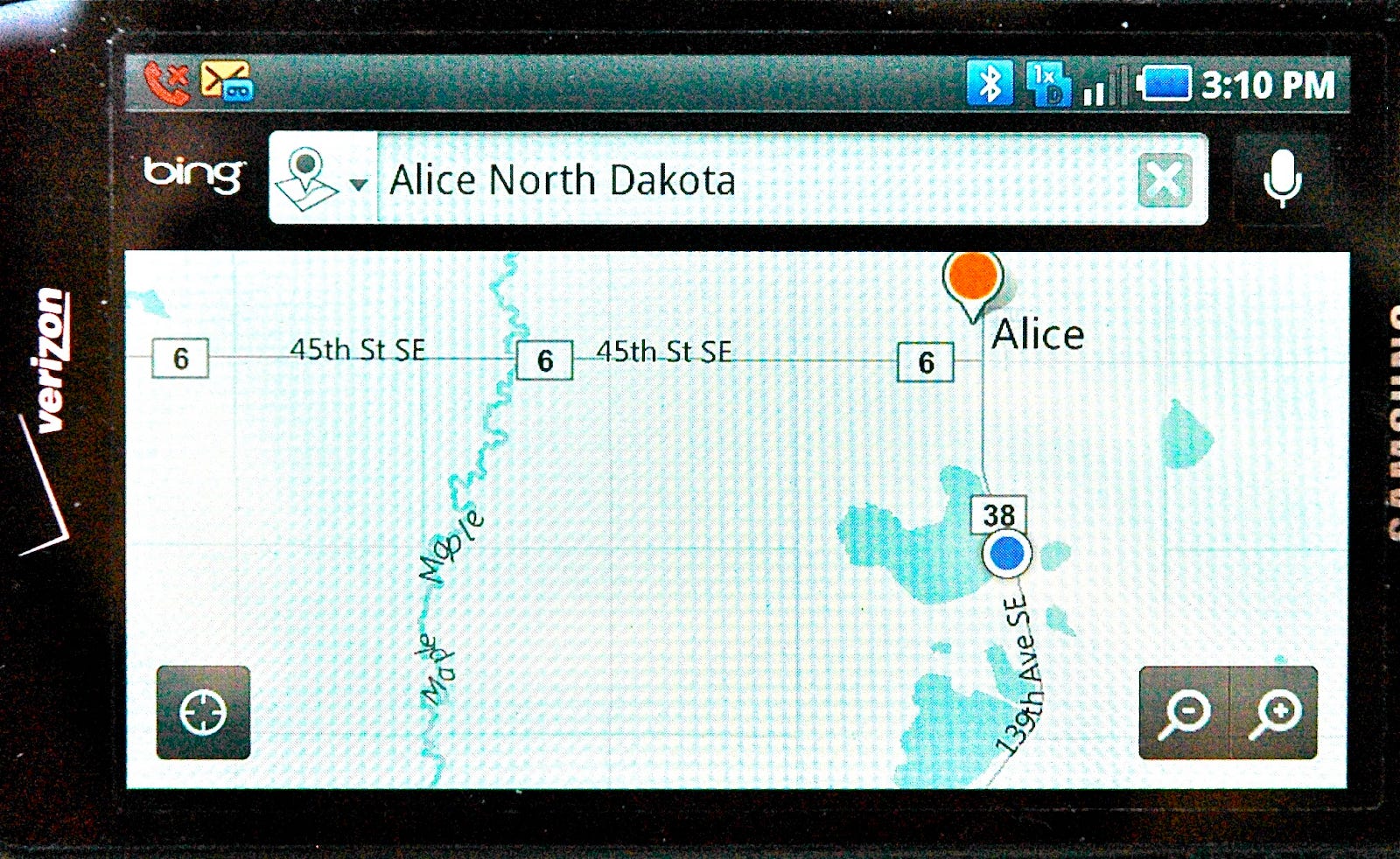
That piece of trivia wasn’t exactly a reason to alert the Pulitzer Prize committee. But I also already knew there were some yawning discrepancies between what Steinbeck wrote in his nonfiction book and what he actually did or did not do on his trip. At times during the festival it was hard to keep from screaming out that Emperor Steinbeck didn’t have on all of his nonfiction clothes.
I suddenly realized: I know much more about Steinbeck’s road trip than they do. It was a terrifying feeling. For the first time in my life, I was the expert in something, albeit a very minor, esoteric, inside-baseball something no one else cared about. In August of 2010, I had already become the global authority on John Steinbeck’s road trip, completely by accident. And I still hadn’t read the first draft of Travels with Charley or driven a single mile down the Old Steinbeck Highway.
How did you get into journalism? What drew you to the field and kept you there?
It was my parents’ fault. I had no choice but to become a journalist and op-ed columnist—for genetic and environmental reasons. My Canadian mother was a journalism major at Pitt in the late 1930s who thought FDR was a god. My father was a witty, sarcastic and super-opinionated conservative Republican who worshiped Count Basie and William F. Buckley Jr. and subscribed to Human Events.
Our house on the suburban frontier of Pittsburgh was saturated with news and opinion. I and my younger brothers John and Paul, who would have long careers as prominent Pittsburgh sports broadcasters, grew up surrounded by the important print and electronic media of the Eisenhower–JFK era.
Two Pittsburgh daily papers were delivered to our house by paperboys like me. My father, a modestly successful stockbroker, brought the Wall Street Journal and the New York Daily News home from work every day. Time, Newsweek, Look, Life, Sports Illustrated, the Sporting News, and National Review arrived constantly by mail. For a decade a new Landmark nonfiction book for kids about Ben Franklin or the Pony Express arrived every month, slowly turning me into a future history major.
I went to Villanova, graduated in 1969 without any honors, got married, had two kids and worked in Pittsburgh for R.J. Reynolds Tobacco as a sales rep. Wanting to add my then-conservative opinions to the liberal mediasphere of the time, in 1973 I went off to get a master’s in journalism at Penn State, where I seemed to be the only non-liberal student or professor.
When my marriage blew up, I moved to Cincinnati, got a job as a writer/editor at a 5,000-circulation suburban paper for 75 bucks a week and learned how to be a good community journalist. I also learned how to be a bartender so I could afford a car and apartment.
In 1977, at age 29, I moved to Los Angeles and landed a job at CBS Television in its docudrama department. I was a fact-checker whose job it was to make sure that made-for-TV movies about real people and real events were true enough to be billed as true stories. The job was perfect for me, but CBS was interested in ratings, not historical truth.
After six months, I quit over the network’s heavy fictionalizing of what it promoted as the “true story” of Dr. Mudd, the country doctor who was imprisoned after treating John Wilkes Booth’s broken leg after he shot Lincoln. (Dr. Mudd, played with maximum sympathy by Dennis Weaver, was portrayed as a twentieth-century liberal punished for doing a good deed for a stranger; he was actually Booth’s pal, a slave owner, and involved in the assassination plot.)
Luckily, I soon slipped in a side door at the mighty Los Angeles Times and became a copy editor, freelancer and letters editor in its popular Calendar entertainment section. The LA Times was then one of the richest, most powerful, and relevant newspapers in the U.S. Its circulation was 1.2 million or so in the 1980s and it had bureaus around the world and in DC. Now its circulation is less than 200,000.
When I returned to my hometown of Pittsburgh in 1989, I worked at the liberal Democrat Post-Gazette in the 1990s and the conservative/libertarian Tribune-Review in the 2000s. I did hundreds of weekly Q&As with smart and famous people like John Kenneth Galbraith, Thomas Sowell, Ted Sorensen, and Nikita Khrushchev’s rocket-man son, Sergei. I also wrote more than a thousand weekly op-ed pieces and columns on magazines.
I had a long pleasure cruise in journalism in the last Golden Age of Print. I had adventures only journalists could: A trip to Lima, Peru, to ride a freight train into the Andes. Chasing tornadoes for a week at a time in Kansas—twice. Flying through Hurricane Bonnie in 1998 at 10,000 feet and then waking up in her eye when she came ashore in North Carolina.
I watched a dozen movies being made. I spent quality time with or interviewed too many famous, important or smart people to recount—from actor Jimmy Stewart and Charles Bukowski to Tommy Lasorda and Milton Friedman.
I shook hands with Hillary Clinton and Karl Rove when neither knew I was a working journalist. I ate a bag lunch with the historic Jane Jacobs. I helped elderly John Kenneth Galbraith down a flight of stairs and was helped on with my raincoat by William F. Buckley Jr. In Beverly Hills, when I interviewed Timothy Leary on his front lawn, he gave me drugs—two aspirin.
I stayed in journalism because every workday was enjoyable, most of my colleagues were great people and 99 percent of the time I was able to write the stories I wanted and say the libertarian things I wanted to say. I always tried my best to make the newspapers I worked for more interesting, entertaining, and ideologically balanced. I figure I wrote 2 or 3 million words under my byline by the time I quit newspapers in 2009. I’m still waiting for my Pulitzer, which I would love to be able to refuse.
Describe your investigative process when it came to uncovering the facts in the Steinbeck story.
As I said in Dogging Steinbeck, I thought writing a book about America hooked around Steinbeck’s trip would not be complicated or controversial. I figured I’d simply retrace the trail he blazed as faithfully as possible, as a journalist, using Travels with Charley as my guide, map, and timeline. But when I reread the book I quickly learned Charley made a lousy map.
Though it was a nonfiction book filled with real places, real people and real events, it was often vague and confusing about where Steinbeck really was on any given date. It was not a travelogue, not a serious work of journalism and, as I soon realized, it was not an accurate, full, or reliable account of his actual road trip.
Since Steinbeck, who died in 1968, left no notes, no journal, and no expense records from the road, I had a lot of work to do. I plotted every town and highway he mentioned in Travels with Charley on a 1962 road atlas. I read the major Steinbeck biographies. I called up scholars and archivists.
In the spring of 2010 I traveled to central California’s magnificent Monterey Peninsula—a.k.a. “Steinbeck Country”—to do research at the National Steinbeck Center in Salinas and scout old Steinbeck haunts like Cannery Row. I visited libraries at Stanford and San Jose State, looking for clues of time and place in letters he wrote from the road and in old newspaper articles.
In August I went to the Mudd Library at Princeton and the Morgan Library in New York City, where I spent three days reading the cursive scrawl of Steinbeck’s first draft to see how it differed from the published book.
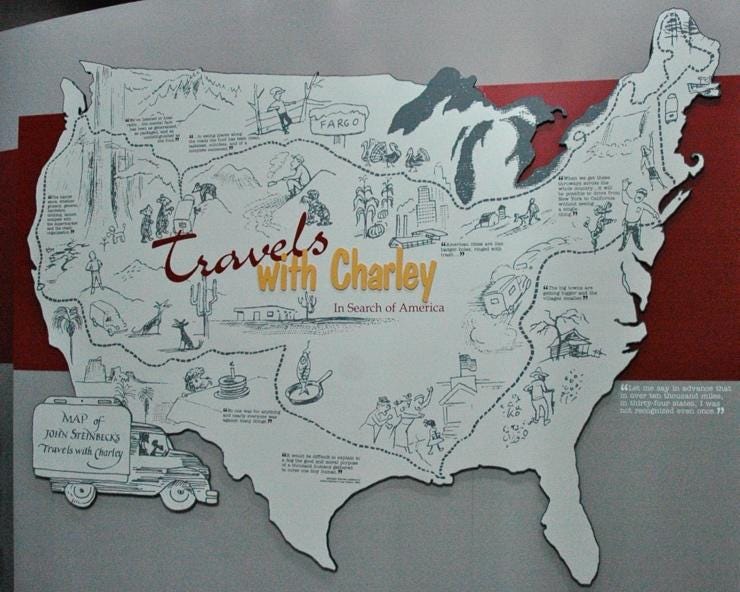
Then on September 23 I left Steinbeck’s seaside house in Sag Harbor exactly 50 years after he set out on his trip with Charley. For the next six weeks I retraced Steinbeck’s route as closely as possible, trying to imagine what Steinbeck might have seen, going where he stayed overnight and interviewing people who met him.
Give us the backstory on your decision to retrace Steinbeck’s journey.
Simple and innocent. In 2009 I was looking for a book to write and somehow I stumbled on the fact that the fall of 2010 would be the fiftieth anniversary of Steinbeck’s road trip. I figured retracing his route as faithfully as possible would make a good book. It’d be a clever way to see how much America had changed since Steinbeck saw a thin slice of it during the Nixon–JFK presidential race in 1960.
I picked out an agent in New York City, Peter Rubie, because he was an author, a jazz guitarist, and a former Fleet Street newspaper guy from London. I successfully pitched him with an email and wrote a good book proposal for my idea that he pitched to dozens of book editors. We went 0 for 30-something. I was a nobody. No one cared about Steinbeck anymore. No book editors embraced the idea of retracing his Travels With Charley trail, even though over in the Netherlands the great Dutch intellectual and newspaper editor Geert Mak was preparing to retrace it for what would become his bestseller, In America: Travels With John Steinbeck.
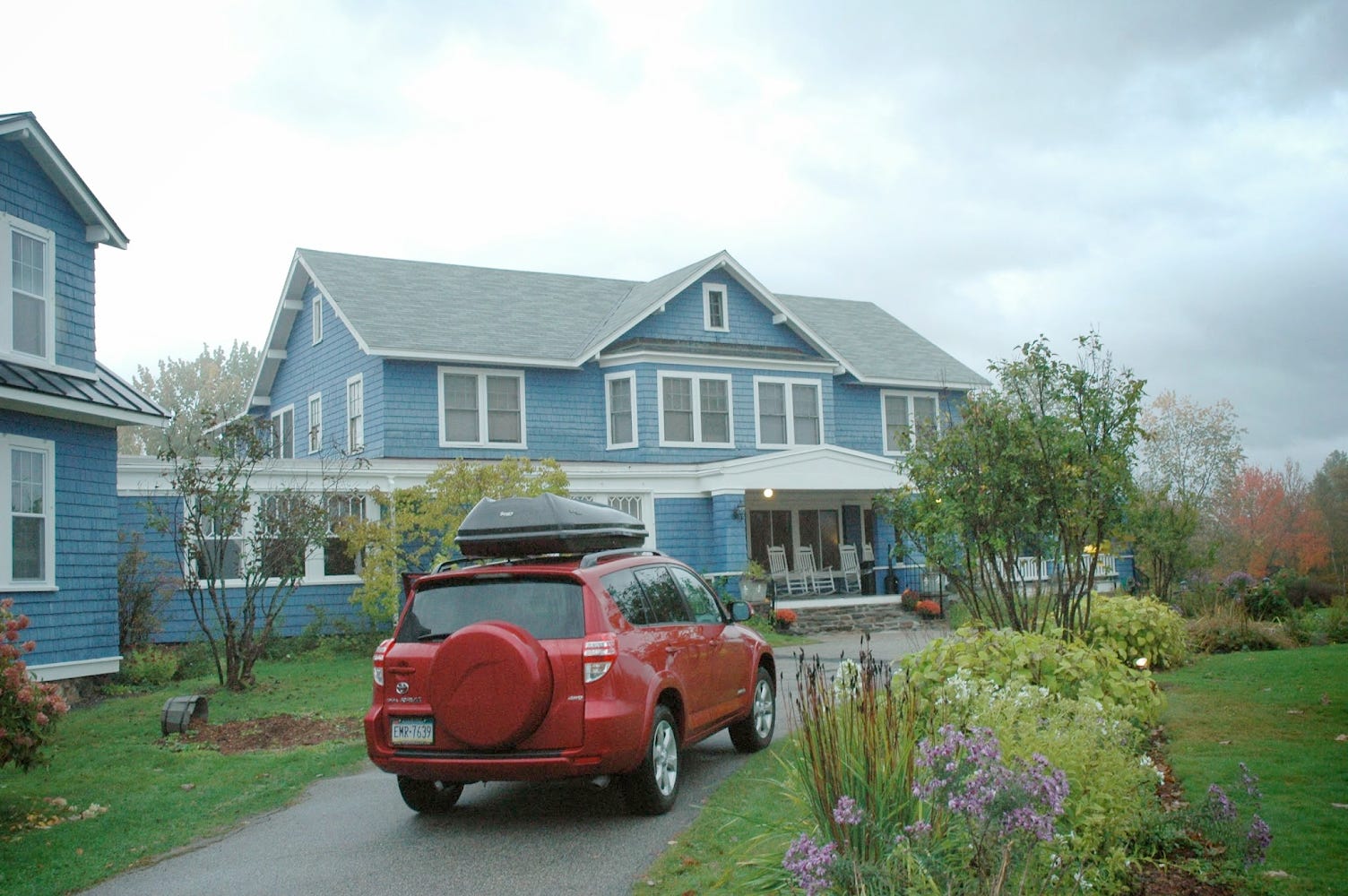
Screw ’em all, I decided. I’ll do the trip and self-publish the book on Amazon. Maybe I’ll get lucky and be abducted by aliens. In any case, I had invested too much in the idea. I leased a new RAV4 after making sure I could sleep in the back on a mattress. My wife made blackout curtains that proved to be priceless in brilliantly lighted Walmart parking lots from Maine to Washington state. I bought a video camera, a new smart phone, packed a dozen Professional Reporter’s Notebooks and hit the road to Sag Harbor—doglessly.
How does reality square with the impression Steinbeck desired to make? What were the biggest whoppers he told?
Travels With Charley was marketed, sold, and reviewed as a nonfiction account of Steinbeck’s road trip in search of America. It hit No. 1 in the New York Times’s nonfiction best-seller list. But the editors slyly edited the first draft of the book. They made it appear that one of America’s greatest authors had traveled alone, traveled rough and traveled slow for 10,000 miles, camping out under the stars often as he searched for the America and Americans he had lost touch with.
But he didn’t do any of those things on his 75 day road trip.
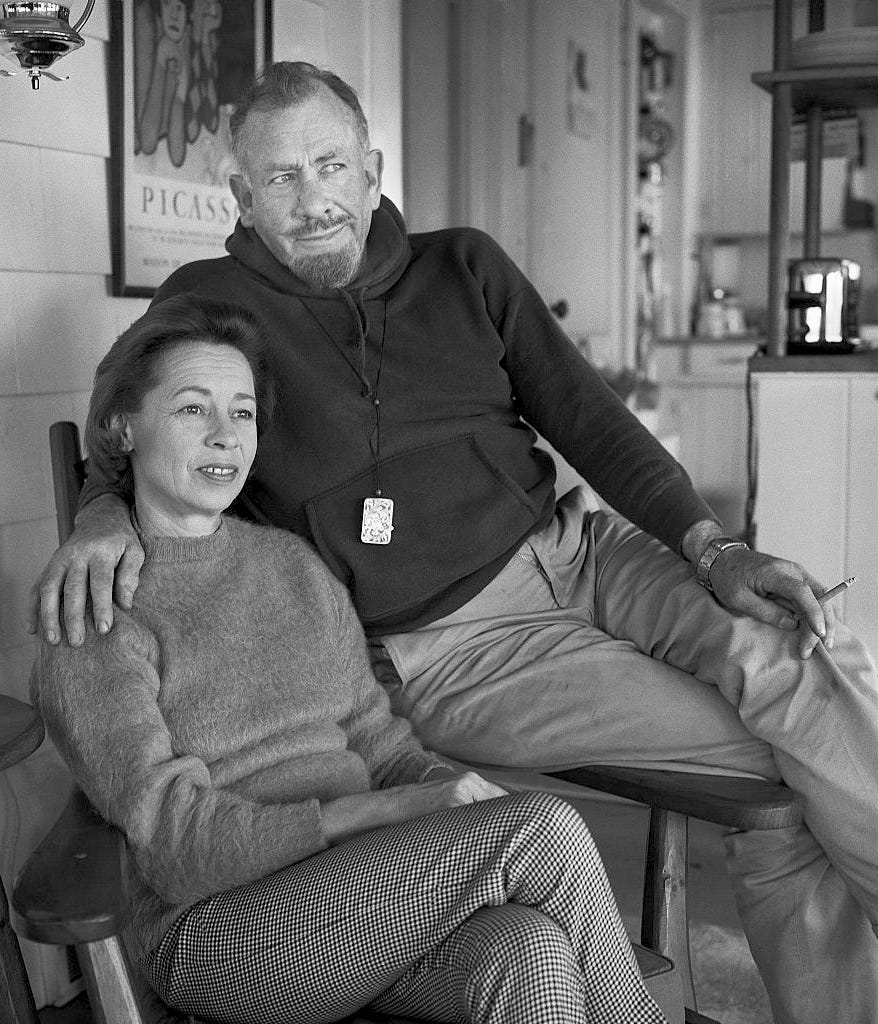
In fact, he traveled with his wife Elaine more than half the time. The couple spent an entire month together on the West Coast. As they drove from Seattle to San Francisco in the camper truck, they moved slowly through Redwood Country and stayed at fancy resorts. After that they stayed for about two weeks at the Steinbeck family’s seaside cottage in beautiful Pacific Grove.
As for camping out under the stars, Steinbeck may have done it a few times. But mostly he slept in luxurious private homes in Maine and Texas, modern motels and the finest old hotels in Chicago and San Francisco. And when he drove alone from Maine to Chicago, from Chicago to Seattle, from Monterey to Texas and from New Orleans back to his home in New York, he didn’t stop to meet his fellow Americans. He drove as fast as he could.
The Travels with Charley myth is the book’s biggest whopper. Steinbeck’s first draft revealed much more of his actual trip, including a handful of embarrassingly dull West Coast scenes starring Elaine. But to preserve the romantic theme of a man traveling with his dog, Viking’s smart editors cut her out of the book and replaced her with the book’s star character—Charley.
Travels with Charley is riddled with little whoppers, fictions and rearrangements of time and place that don’t matter to anyone and don’t disqualify it as a work of nonfiction. But Steinbeck clearly made up a parade of suspiciously cardboard characters he said he met.
The least believable one was the itinerant Shakespearean actor he said he befriended while camping out in the middle of the endless wheat fields of Alice, North Dakota. Actually, as he betrayed in a letter he wrote to Elaine, that night he was taking a hot bath in a motel in Beach, North Dakota. Steinbeck also left out some interesting stuff he did on his actual trip, including his overnight visit with his pen pal Adlai Stevenson near Chicago, his stay at a shiny modern motel in Seattle and his five-day layover in San Francisco with his old friends.
In some ways this feels like a battle of disciplines, the novelist vs. the journalist. Why should we care that Steinbeck fudged the story? Isn’t that what novelists do?
It is discipline vs. discipline. Novelists play around with facts. Journalists—in theory—stick to them, protect them, and even worship them. At one point, before I published Dogging Steinbeck, I wrote in the Pittsburgh Post-Gazette that what Steinbeck did to fictionalize Charley was no big deal:
Travels with Charley has always been classified as a work of nonfiction, but no one ever claimed it was a “Frontline” documentary. Does it really matter if Steinbeck made up a lot of stuff he didn’t do on his trip or left out a lot of stuff he did do? Should we care that Charley could never be certified as “nonfiction” today. . . ?
All nonfiction is part fiction, and vice versa. It’s not like Steinbeck wrote a phony Holocaust memoir that sullies the memories and souls of millions of victims. . . . It doesn’t matter if it’s not the true or full or honest story of Steinbeck’s quixotic road trip. It was never meant to be. It’s a metaphor, a work of art, not a AAA travelogue.
But for my book I did a 180. I said that at first I had been satisfied merely exposing Steinbeck’s trickery and deceit. I had been a literary detective. I didn’t feel qualified to be the prosecutor or the judge. That was a job for people with PhDs in literature. “My work is done,” I wrote. “I’ll let the scholars sort out whether Steinbeck’s ghost deserves to be hauled on to Oprah’s stage to defend himself for his 50-year-old crimes against nonfiction.”
Boy, was I naïve. I actually thought Steinbeck scholars would be disappointed to learn that a great American author had been caught in a major lie. They weren’t. I thought they’d care. They didn’t. I thought they’d thank me for my hard work, or maybe give me an honorary degree in something. Hah.
In a few weeks I returned to my senses. I clearly wasn’t thinking straight when I wrote that it didn’t really matter what Steinbeck and Viking Press had done to twist and hide the truth. Of course it mattered. I was a journalist. Finding out the truth about Travels with Charley—or anything else—did matter to me. It had been my career to seek truth and report facts. Truth, big or small, should always matter to any honest journalist, no matter what their politics or biases were.

The New York Times covered your corrective and Reason magazine featured an article by you on the subject. How has your take on Steinbeck’s story been received overall and by the specialists?
Wikipedia’s Travels With Charley citation mentions my corrective, though it underplays the extent to which it is fictionalized. Whenever I see someone writing about the book now, they usually mention that its veracity has been seriously sullied by somebody or other and it is now considered a work of fiction.
My fellow journalists generally support me. They, the New York Times editorial page, and the great travel writer Paul Theroux think what Steinbeck did was a literary crime—“something of a fraud,” I like to say. They think he should be called out and shamed for what he did. Steinbeck, who was a good novelist and a lousy journalist, isn’t entirely to blame. He’s guilty for going along with Viking’s nonfiction packaging. But it was the editors and Viking’s marketers who reinforced the Charley myth and perpetuated it for half a century until I came along and made them fess up.
The Steinbeck scholars think I was nuts and unfair to beat up a novelist like Steinbeck for fudging around with reality. They think I made a big nitpicking deal out of the obvious. Of course he was going to throw a bunch of fiction into Charley, they say. He was a novelist, for Pete’s sake. We knew it all along. We just didn’t want to share it with the rest of the world.
It’s funny what the Steinbeck scholars have finally done in reaction to my troublemaking. They collected an all-star team of experts and had them write essays for a book that’s coming out in December from Alabama University Press. Called Steinbeck’s Uneasy America: Rereading Travels With Charley, it is sure to be stuffed with excuses and new genres like “fictive travelogue” for what Steinbeck did to reality.
What separates what you did from the “do your own research” approach common on social media?
Nothing really. Journalists—good and honest ones—do their own research all the time. That’s their job. I used to say that a good journalist has to know how to invade specialized professions or subcultures, figure out what’s going on by asking questions and observing, and then write up an interesting (and entertaining) story explaining everything so their mother could understand it.
Anyone who’s curious and persistent can practice good journalism. No occupational license required. No special college degrees. That was always true. But the Internet has shattered the legacy media’s monopoly on news and information into a million pieces and democratized journalism. Bloggers, doctors, and comedians like Joe Rogan do good journalism now.
As journalistic outlets fold and recede, how can those of us who value the work done by journalists ensure that we don’t entirely lose the benefits of the practice?
Don’t trust and verify is good advice for the future. Journalism is more diverse and untrustworthy than ever, and that’s saying something. But I bet the market will figure out how to provide the reliable reality-based information we need and want. Rich people, Big Tech, and wealthy institutions like universities will publish it. Maybe print will make a comeback like vinyl. Maybe we’ll see the return of pamphlets.
People worry about AI replacing or destroying journalism. But I bet it will turn out to be a great tool for journalism. It’ll require sharp editors. But think how many writers and reporters will be saved from doing tedious grunt work like rewriting press releases and freed up for more important stories.
Final question: You can invite any three authors for a lengthy meal. Neither time period nor language is an obstacle. Who do you pick, why, and how does the conversation go?
Frédéric Bastiat, Ambrose Bierce, and Steinbeck. Bastiat is my great hero—a superior journalist and propagandist of freedom who taught the principles and fallacies of economics to the public in an entertaining way. I’d ask him what he thinks about the present and future of America. I’d ask Bierce, America’s cleverest journalist, to update his Devil’s Dictionary. As for Steinbeck, I’d ask him if he is sorry for faking so much of his Charley trip, tell him I don’t hate him for changing my life, and assure him I am only kidding when I call him “a lying bastard.”
Thanks for putting in the miles and doing the legwork. One great possibility of our Century 21 situation is the ascendance of a significantly increased capacity for ‘warts-&-all’ appreciation. We have to do it IRL and the familiar habits of canonization are worn out, overdue for the dustbin. Read something in a similar vein recently about Zen and the Art of Motorcycle Maintenance. The treatment dated to about the same time as yours. Funny that Robert Pirsig had probably covered a bit of the same ground, literally and figuratively.
That would be amazing! Barnettjess.ca@gmail.com