

In 2002 I wrote this article about Epiphany for the Pittsburgh Tribune-Review because Richard Scaife, the Trib’s owner and the church’s generous patron, thought it was a good idea. He was right.
A miracle of survival
Sunday, Aug. 18, 2002
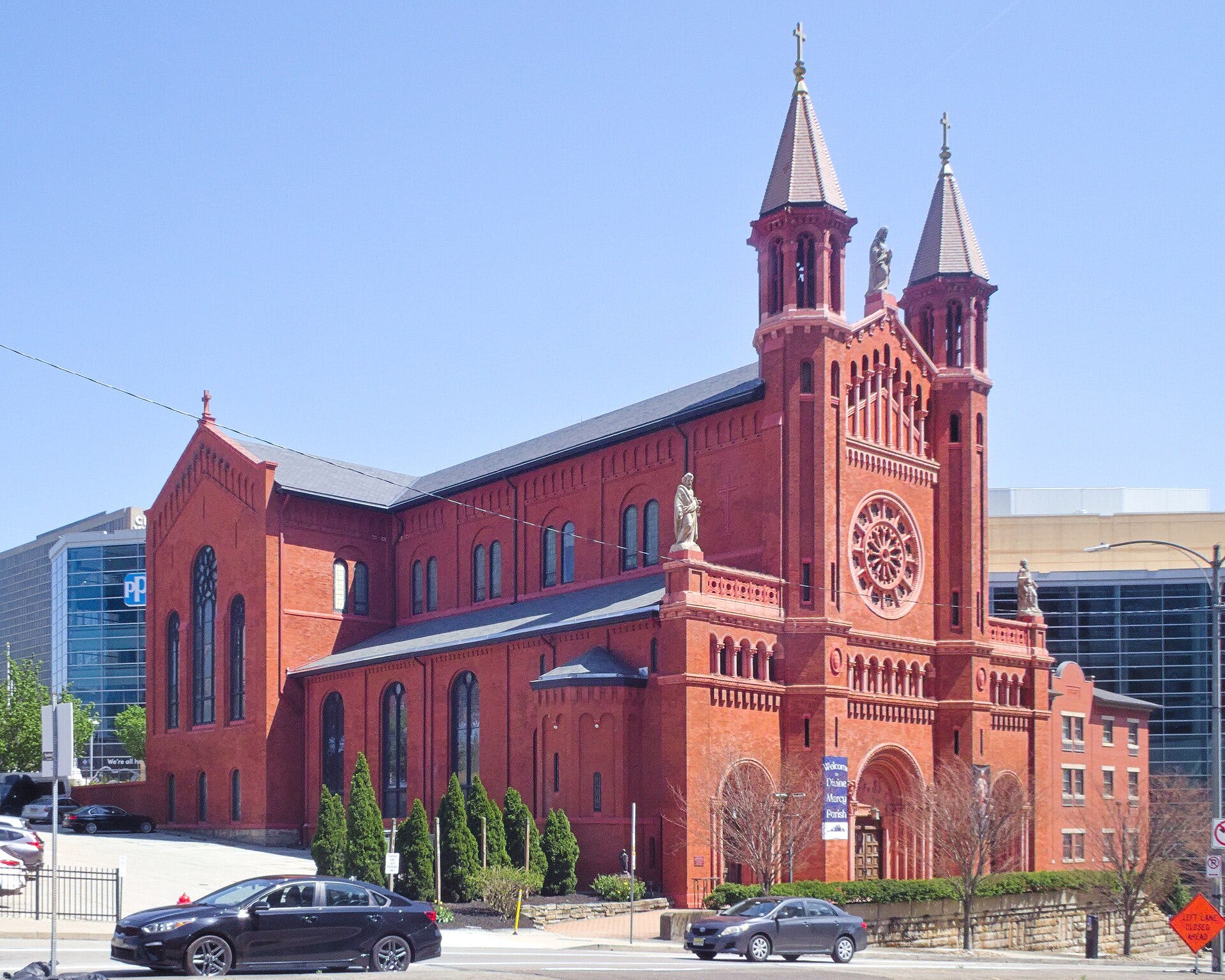
Long ago, its twin steeples and stained-glass windows looked out over a poor but bustling city neighborhood.
For decades, its priests and nuns tended to the religious, social and cultural needs of a crowded parish of immigrants who had come to Pittsburgh to work in the humming factories and mills.
And for more than 50 years, its tight compound of buildings — church, parish house, grade school and a hotel for single working girls — was a fortress of faith, hope and charity for Catholics living in the Lower Hill District’s rich collection of row houses, cheap apartments and crowded slums.
But that was another century, when Epiphany parish was young and part of a seamless, smoky sprawl of humanity and manufacturing that stretched from the Point to the quiet pastures of Oakland.
Today, Epiphany Catholic Church stands conspicuously alone at the corner of Centre Avenue and Washington Place.
Its earthy red bricks — not to mention its cross-topped spires and medieval-style architecture — are out of place and time in the sparse skyline of gleaming metallic buildings like Chatham Center and Mellon Arena.
The church has been stranded in its purgatory of asphalt, concrete and traffic since the late 1950s, when the Lower Hill was obliterated to build the Civic Arena during urban renewal. Now another major redevelopment project threatens to transform Epiphany’s neighborhood.
The project is a new $270 million hockey rink for the Pittsburgh Penguins. The arena and attendant retail development, which would replace Mellon Arena, has been proposed for the site of the now-shuttered St. Francis Central Hospital, Epiphany’s neighbor.
The footprint of the new arena comes dangerously close to Epiphany property. But both the Catholic Diocese of Pittsburgh and the Sports & Exhibition Authority, the city-county agency that would oversee the proposed project, say the Penguins’ new home would pose no threat to the 100-year-old church.
In fact, based on preliminary redevelopment plans for the Lower Hill that include new housing, Epiphany’s barren parish could start filling up again with the kind of urban life forms it once had by the thousands — people.
It’s a miracle Epiphany church has survived to see its 100th birthday, a milestone the parish marks at noon today with a Mass celebrated by Bishop Donald Wuerl. A banquet for current parishioners and former parish priests and nuns will follow in the church’s basement parish hall.
Fifty years ago, Epiphany looked like a goner. To make way for the Civic Arena and a culture-and-arts mecca that never materialized, the city demolished more than 1,300 structures, displaced nearly 10,000 people and clear-cut 95 acres of Epiphany’s immediate neighborhood.
By 1961, Epiphany’s four brick buildings were the only ones left. The Lower Hill and the rainbow of nationalities and ethnic groups living there were history.
So was most of Epiphany’s congregation of about 2,000 big families, most of them Irish. The number fell quickly to 350, which is how many families there are now.
The congregation today includes residents of Crawford Square and the Washington Plaza apartments. But according to its pastor, the Rev. James Garvey, its core flock is composed of office workers, older people who once lived in the parish but now live in the suburbs, university students and the homeless.
Epiphany parish has changed radically. Yet Garvey says his church — like any other Catholic church — is still an important part of its community. It’s just a different community.
A NEIGHBORHOOD CORNERSTONE
Epiphany Church was born out of necessity in the early 1900s, when steel baron Henry Clay Frick bought St. Paul Cathedral at Grant Street and Fifth Avenue, Downtown, and erected the Frick Building on the site.
While a new cathedral was being built in the then-boondocks of Oakland, the Church of the Epiphany was established in 1902 to serve Catholics who lived or worked Downtown.
Epiphany’s first services were held in what is now the church’s basement parish hall. But by 1910, the new church and the other parish buildings were finished.
Designed in a Romanesque-meets-Byzantine architectural style, the church had high arches, deep vaults and lofty naves. Outside, perched high above the front doors, were the statues of Jesus, St. Peter and St. Paul that had graced the first St. Paul Cathedral.
Inside, under a 60-foot central dome, the church’s signature stained-glass windows told the story of the Epiphany — the event in which Jesus is said to have been revealed to the gentiles as Christ by the Magi who came to visit him at his birth.
The total cost of the church was $386,016 — about $7.3 million in today’s money. But all of today’s money and much more couldn’t duplicate the Old World workmanship and artistry that went into Epiphany.
Nor could it still buy the white Italian marble of its altars and altar steps. Or its priceless Venetian enamel mosaic of the Epiphany above the main altar. Or its European-cast bronze crucifixes and Communion-rail doors.
Thanks to its founding pastor, the Rev. Lawrence O’Connell, Epiphany quickly became the center of its neighborhood’s social and cultural life. The parish grade school, staffed by the Sisters of Mercy until it closed in 1973, enrolled as many as 1,175 students at its peak in 1918.
Across the street, O’Connell built the Lyceum, which was lost during urban renewal. Plays and operas were put on in the Lyceum, and famous lecturers visited from around the nation. During the day, its gym kept parish toughs like Harry Grebb and future world heavyweight contender Billy Conn off the streets and taught them how to box.
In 1913, when O’Connell built the St. Regis Home-Hotel for Business Girls, a residence for young single women who had moved to the city, the Epiphany compound that still stands today was complete.
The resourceful O’Connell, who died in 1959, served 54 years as pastor and became a prominent figure in the city’s charitable circles. He founded Camp O’Connell for needy kids in 1937 and also was responsible for one of Epiphany’s most famous contributions to the city — the “Printers Mass.”
It started in 1903, when seven daily newspapers published Downtown. The papers’ printers and typographers, who on weekends worked from Friday straight on to early Sunday morning, asked O’Connell if Epiphany could schedule a Mass for them at 2:30 a.m. Sunday, so they could attend immediately after work.
This was the era when Masses where supposed to be celebrated only from dawn to noon on Sunday — except for Christmas midnight Mass. But O’Connell got special authorization from Pope Leo XIII, and the Printers Mass was born.
At its peak, it attracted nearly 1,500 newspapermen. The Printers Mass, which lasted until 1991, eventually also became popular with the late-night crowd and students at nearby Duquesne University.
Through the 1960s, as its original congregation evaporated further, Epiphany concentrated on renovating its buildings and doing worshipper-friendly things like adding Masses during workdays. By the 1970s, it had assumed its current identity as a “Downtown parish.”
AN EVOLVING MISSION
Epiphany’s pastors have always had a knack for catering to the heavenly and earthly needs of their unique flock. A century ago, that meant teaching English to freshly arrived immigrant families or running a Catholic grade school for their children.
Today, it means renting office space to social agencies, like Dress for Success, Pittsburgh, which helps women make the transition from welfare to work, and scheduling convenient morning, noon and evening Masses during the week for Downtown office workers.
Sunday services average about 100 worshippers, said Garvey, who has been pastor for about a year. Noon Mass draws the most people during the week — usually 65 or 70. On a holy day, when an 11:15 a.m. Mass is added, as many as 800 attend.
On a recent hot and miserably humid Monday, however, as Epiphany’s cavernous interior is bathed in a dim gold and caramel-brown glow, only 15 people show up for 5:15 p.m. Mass.
On the streets outside, busses hiss and trucks groan in rush-hour traffic. In the distance, a police siren wails. But inside the church, which can hold 1,000 comfortably, the silence is broken only by the gentle whir of several ineffective electric fans.
At 5:15, with sunlight struggling to penetrate the stained-glass windows, Garvey enters the sanctuary wearing his vestments. His altar “boy” is an older man in denim shorts, a T-shirt, white socks and black shoes.
Also assisting is Ken Scherer, a retired Duquesne Light public relations executive who volunteers for just about every job at Epiphany that doesn’t require the sacrament of holy orders. Scherer reads from the Book of Jeremiah, passes around the collection basket and helps Garvey distribute Communion.
One of the 15 attending Mass is Dave Kutcher, 54, of Brighton Heights, an active volunteer at Epiphany who works Downtown for the Department of Veteran Affairs. After the service, he describes himself as a staunch Catholic who visits Epiphany every afternoon to view the Eucharist, which is displayed on a side altar from noon to 5:30 p.m. It’s something few Catholic churches do, Kutcher said.
Also at the Mass are four Wilt siblings from Mt. Washington — John, Connie, Paul and Christine, who are marking the 25th anniversary of the death of their mother, Genevieve. They chose Epiphany because the Mass is convenient to their work schedules.
Four days later, Friday’s noon Mass draws about 40 people, not counting the homeless man who is working the front door asking for lunch money.
But what was bringing scores of people like mail-truck driver Don Bowman, of Pine Township, to Epiphany’s door is what goes on in the church basement every Friday from noon to 6:30 p.m. — the parish fish fry.
About 200 customers come each Friday, said Scherer, who serves as cashier. Things like meatball sandwiches, pirogies and sometimes ribs are on the menu. But the No. 1 seller by far is the $5.50 fried Atlantic cod sandwich.
The fish fry is the 4-year-old brainchild of the Rev. Dan Sweeney, the previous pastor. It’s been a great success, Scherer said. The profits are paying for enlarging and remodeling the basement parish hall, which had sat unused for 35 years.
Usually, it is Mellon Arena workers like Hank Orosz, of Shaler, and Frank Falce, of Brookline, who form the fish fry’s regular customer base. But business booms when daytime events at the arena deposit thousands of potential customers at the doorstep.
In March, when an NCAA regional college basketball tournament visited the arena, Scherer said, the church sold 1,200 pounds of cod — the most ever. Even scalpers came over.
THE NEXT HUNDRED YEARS
According to preliminary redevelopment plans for the Lower Hill, new homes may sprout again on the site of Mellon Arena, which would be demolished.
Closely watching the outcome of this 50-year cycle of destruction and creation, Epiphany’s pastor has hopes the Lower Hill will be reborn as a residential neighborhood.
Until then, Garvey said, Epiphany will continue to do the same thing it’s been doing for 100 years — “to preach the gospel and celebrate the sacraments for the people of God.”
Meanwhile, he said, the church is in the middle of a $1 million fund-raising drive to continue its many restoration and renovation projects. It is in no mortal danger from a new Penguins arena.
Greg Yesko, spokesman for the Sports & Exhibition Authority, said Epiphany’s property “is not at risk.” And the Rev. Ron Lengwin, spokesman for the Catholic Diocese of Pittsburgh, is equally emphatic.
“It is our intention for that parish to remain there,” Lengwin said.
He cannot guarantee that Epiphany church would be there 100 years from now — no one could, he said. But “it was there before the arena,” he added, “and we expect it to be there for a long time.”