
Tornado Chasing 2.0 in the year 2000
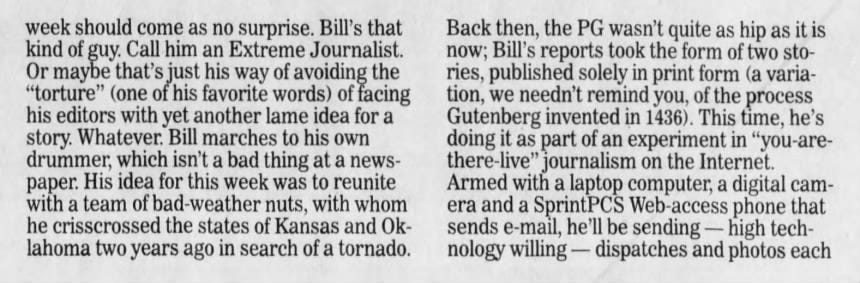
As I did in 1998 I joined a gang of chasers in Tornado Alley who were looking for a twister. A pioneer of the digital age, I used a cell phone to send stories and pics back to the PG as we drove.

In 2000 it was too early in the Digital Age to pull off this plan to report a tornado chase ‘live’ by posting them on the primative Post-Gazette web site. I ended up calling in a lot of my reports during the days we drove around Nebraska and Kansas.
Poor Matt Kennedy, my editor back in Pittsburgh, had to type up my dispatches and post them.
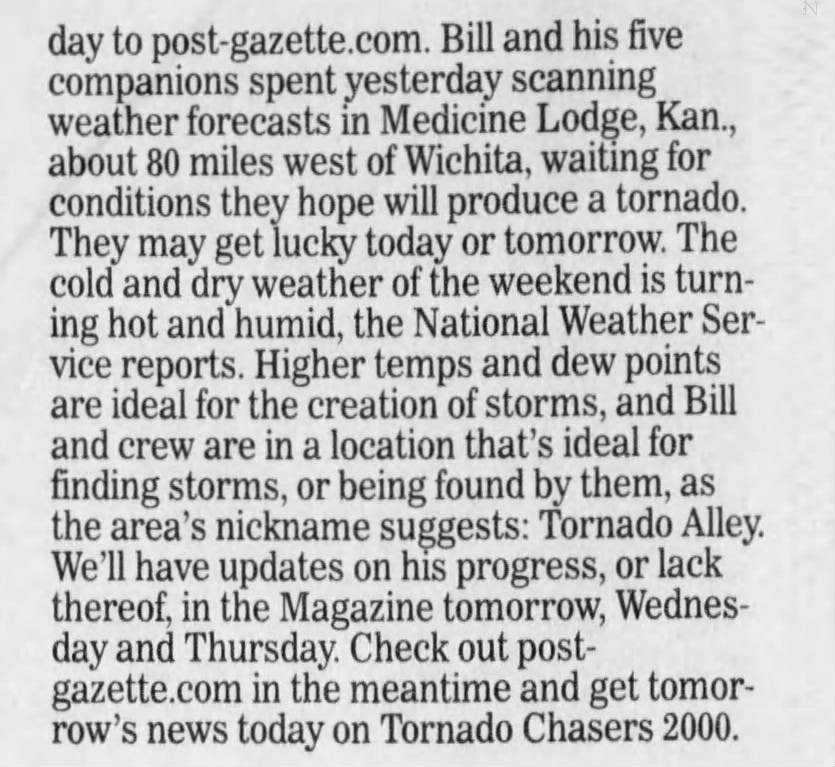
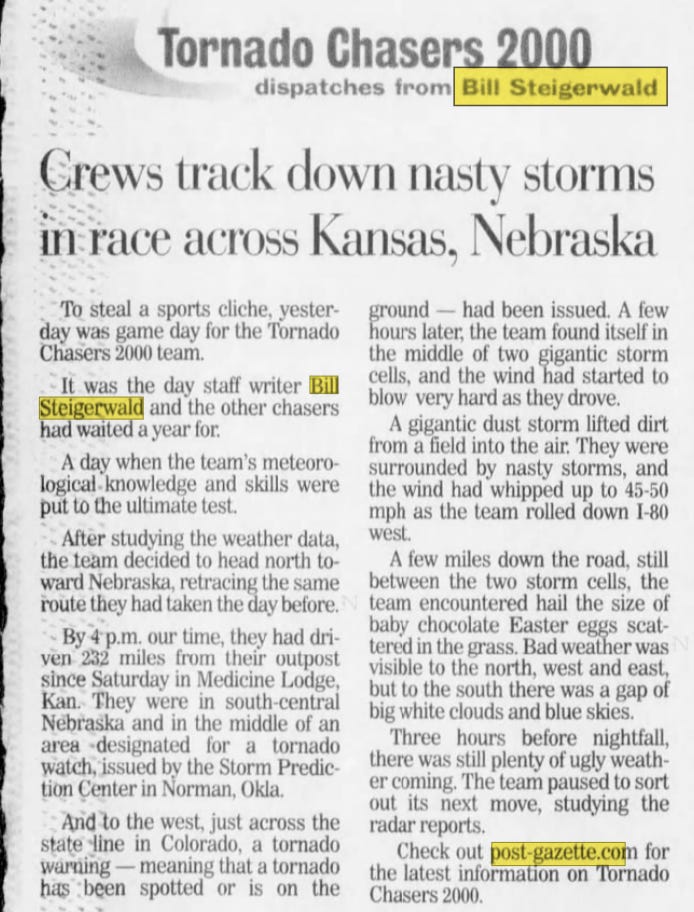
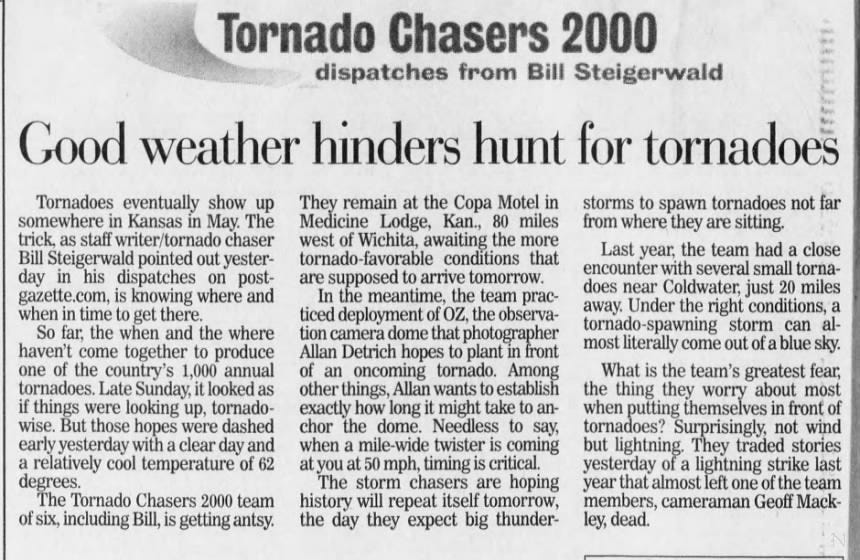
Here’s what ran in the print edition, followed by an unedited version of what was posted on the web site. Some of the days were lost — the PG’s ‘historic’ and pioneering attempt at Internet journalism is no longer available online. Not sure if it exists anywhere except here, thanks to my copying and saving of it many years ago.
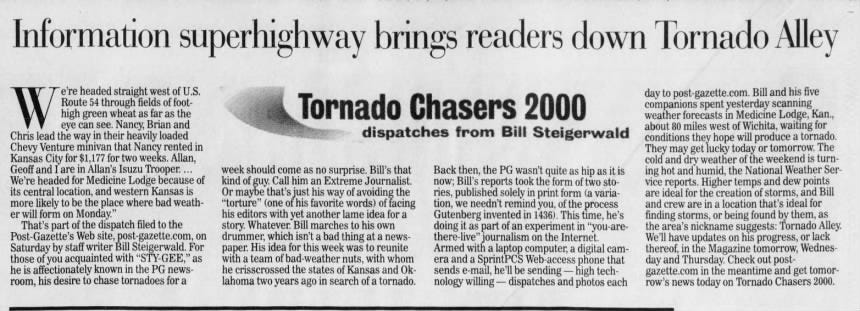
The remnants of the Digital version:
The Tornado Chasers – the 2000 edition
In May of 1998, when the movie “Twister” put the fear of tornadoes on the national mind, I rode with six admitted bad-weather nuts as they crisscrossed the states of Kansas and Oklahoma in search of a tornado.
They found one in four days, thanks to luck and their scientific and intuitive skills. But as I later reported in two Post-Gazette stories, tornado chasing wasn’t quite as glamorous as the movie.
For nine days they slept in cheap motels, ate lousy fast food, studied local radar sites on the Internet and watched the Weather Channel religiously. They drove hundreds of miles some days trying to get to where their calculations said a tornado would be born in the late afternoon.
Although I should have known better, on May 13, 2000, ) I went back to Tornado Alley to chase tornadoes again with the same nice but nutty people.
This time, however, I did it as part of an experiment in Internet journalism. I was armed with a laptop computer, a digital camera and a SprintPCS Web-access phone that could send e-mail. I sent dispatches and photos each day to www.post-gazette.com.
Call it Extreme Journalism (TM). Call it an excuse to get out of cutting the grass this weekend. But we were giving a new kind of “you-are-there-live” journalism a try.
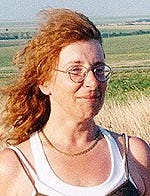
Nancy Bose, 48, is the secretary and founding mother of MESO, the Multi-Community Environmental Storm Observatory, which was founded by members of the 1998 chase team to provide scientific and educational information about severe weather to communities and schools. A self-taught weather expert, she lives in Verbank, N.Y., where she works as car salesman. She and her husband Randy have three teen-age children.

Allan Detrich is a photojournalist for the Pittsburgh Post-Gazette and the Toledo Blade who lives with his wife Mary in Fremont, Ohio. Since covering the first chase in 1998, Detrich has become an avid tornado chaser and is the media director of MESO. For Chase 2000 he has co-invented and built a Plexiglas dome with a camera mounted inside it. Called OZ (Observation Zero), it can be staked into the ground and is designed to be placed as close to a tornado as possible.
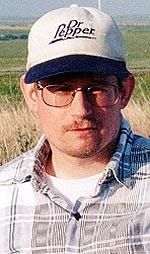
Chris Howell, who was not a member of the original 1998 team, joined MESO for last year’s chase. He is a restaurant manager and lives in Ypsilanti, MI..
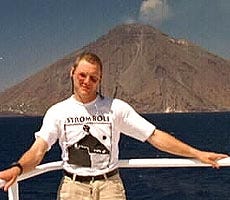
Geoff Mackley, 37, is a danger-seeking TV news cameraman and adventure cameraman from Auckland, New Zealand. An expert mountain climber and long-distance runner, he spends his vacation time lugging his $25,000 video camera to Kansas for tornado chases and to the rims of active volcanoes anywhere around the world.
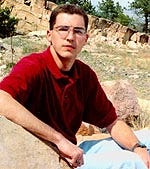
Brian McNoldy, 24, lives in Fort Collins, Colo., where he is an atmospheric science grad student at Colorado State University. The President of MESO, he grew up in Reading, Pa., and graduated with a degree in physics and astronomy from Lycoming College.
Dispatches
Chase Day 1 - May 13
Heading out
Wichita, Kansas
10:30 a.m. CDT
Thanks to a long bad-weather delay in Chicago, when I arrived at the Comfort Suites in Wichita last night my old friends the tornado chasers were already tucked in bed, happy and excited as children to be back in their beloved Tornado Alley.
I think I hear them in the motel lobby now. I’m going to go down and reunite with them after two years.
Whoops! I’m almost too late. Nancy Bose, Geoff Mackley, Brian McNoldy, Allan Detrich and the new guy, Chris Howell, are already in the parking lot, loading up their vehicles.
I’m going to run and catch them. They didn’t know I had arrived late lat night and were almost ready to head out the airport to pick me up. Turns out the French TV journalist won’t be joining us on this chase.
The chase team’s packing up to head out toward Medicine Lodge, about 80 miles west of here. They want to get in position for some big weather heading our way. A cold front has moved in, the same one that brought the bad weather in Chicago last night.
In Wichita the weather now is beautiful, crisp, sunny and cloudless – terrible weather for tornado chasing. Nancy said she’d rather be back home in New York where it’s supposed to be nasty today.
But the warm, juicy weather is coming Monday and they want to be in Medicine Lodge as a base. It’s a rural, flat, one-McDonald’s town where they’ve set up base camps for the last two years -- a good place to chase tornadoes and a central location where they can go south into west Texas or north into Nebraska.
Off we go.
On the road
Midway, Kansas
5:20 p.m. CDT
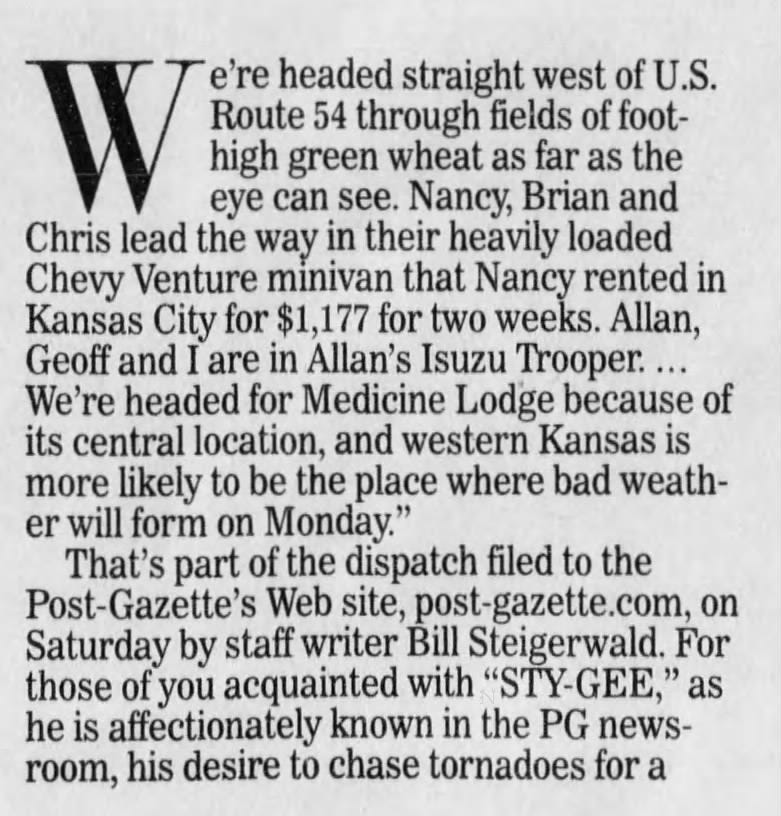
We’re headed straight west on U.S. Route 54 through fields of foot-high green wheat as far as the eye can see. Nancy, Brian and Chris lead the way in their heavily loaded Chevy Venture minivan that Nancy rented in Kansas City for $1,177.00 for two weeks.
Allan, Geoff and I are in Allan’s Isuzu Trooper. On the Trooper’s hood is OZ, Observation Zero, the Lexan dome into which Allan will put a Sony digital video plastic dome, weighs 25 pounds and can be staked into the ground with steel rods. The plan is to get several miles out in front of a tornado, stake OZ into the ground, start the camera and hope that the tornado passes over or near it. Allan hopes to get footage never seen before.Tornadoes aren’t coming our way just now, however. It is still a beautiful blue-sky day. We’re headed for Medicine Lodge because of its central location and western Kansas is more likely to be the place where bad weather will form on Monday.
Chris Howell, 31, who has been studying bad weather in the Great Plains for 15 years, says it’s too cold and too dry for tornadoes. The temperature is 58 and the dew point is 28 degrees – dewpoints in the high 60s are ideal for the creation of storms.
Chris, who is listening tp a NOAA weather report on a portable radio scanner, says this good weather is a case of bad chaser luck. The weather is more Arizona than Kansas in May. But that’s the way tornado chases go. IIt may be the peak time for twisters in Tornado Alley. But Mother Nature doesn’t always cooperate – at least not today.
But moister, warmer weather now rolling over New Mexico and west Texas above the Rio Grande River valley is moving eastward and heading toward Medicine Lodge … bringing unstable weather our way.
The Day’s End
Medicine Lodge, Kansas
10:40 p.m.
It’s so quiet here in the middle of Middle America you can hear a pickup truck door slam a quarter mile away. The Indian Oven, the town greasy spoon, closed 10 minutes ago.
The chase team is ensconced in two $44 rooms at the Copa Motel, where they spent almost a week last year. It’s like a beloved vacation home to them.
To save money, we’re three to a room. It’s like a slumber party for people who work at Radio Shack. Everywhere you look there are cameras, computers, cell phones, printers and luggage.
Geoff Mackley, the world-roaming danger seeker and adventure camera man, is sound asleep on the floor of Room 53. Sleeping on floors is an improvement over his usual beds. In the last six months he’s slept in the festering jungles of Indonesia, on the rocky rims of erupting volcanoes in Japan and on ledges at 18,000 feet on Mt. Aconcagua in Argentina.
In Room 54, Chris, Nancy and Brian have been monitoring various weather sites. Things are said to be looking especially promising for mid-week. Now they’re starting to watch “Something About Mary” on Allan’s DVD-playing laptop. I’m going to join them.
I hope there aren’t any tornadoes in the movie. I’m too tired for any nightmares.
Day 2 - May 14
The Great Plains
U. S. Route 160, Kansas
11 a.m. CDT
We’re off to Dodge City, “the queen of the cowboy towns,” which is 100 miles west and north of Medicine Lodge. It’s easy to see why Kansas is so perfect for tornado chasing – and why so many of its tornadoes don’t hit anyone. With 2.8 million souls spread over a land mass almost twice the size of Pennsylvania, there’s hardly anyone to hit.
The landscape along U. S. 160 is gently rolling, impressionistically splattered with dark green pine trees, carved up by ravines and gullies, rippled and wrinkled with low, scrubby hills. Dots of cattle are scattered out on the range lands in bunches of six or 10 and herds of 50, heads down. They’re everywhere, keeping the grasses mowed unnaturally low on their side of the barbed wire running along the side of the two-lane highway.
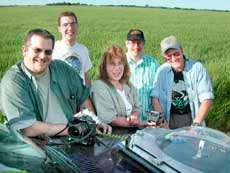
The chase team assembles around Observation Zero, starting with, left, Allan Detrich, Brian McNoldy. Nancy Bose, Chris Howell and Geoff Mackley. (Bill Steigerwald, Post-Gazette)
The calm before
Medicine Lodge, Kansas
10:30 a.m.
Merry Mother’s Day.
The excitement of tornado chasing has been doused by good weather over Tornado Alley.
Weatherwise, not to mention otherwise, nothing is going to happen today. Based on Brian and Chris’ knowing prognostications and crunching of the kind of weather data that meteorologists like Joe DeNardo understand but is too esoteric to torture TV viewers with, the team has decided to stay right here.
The TV weatherman in Wichita is talking about some disturbed air coming across the Rockies and has dropped hints of possible thunderstorms as early as tonight in southwest Kansas.
Today we’ll be stuck in the 70s but tomorrow will be warmer and bad weather will be within striking distance.
By tomorrow this county seat of 2,500 rurally sprawled folks will be the happening place to be. Today it’s a quieter story, a day to rest and wait.
We’ll try to find something to do. But the Kansas High School Rodeo was last month and it won’t be till September that the town celebrates Indian Summer Days.
After 15 minutes, we pass a farmhouse with the standard set of outbuildings protected by mature oak trees. There are steel storage tanks and windmills. And a few, dinosaur-like wells bobbing up and down, taking steady, little sips of oil or natural gas from under the vast emptiness of the Great Plains as they gently rise in elevation toward the Rockies. It’s another 15 minutes before a second farm house whizzes past.
Thirty tornadoes could slice through here in the next 10 minutes and never hit a living thing.
Back from Dodge
Medicine Lodge, Kansas
6:30 p.m. CDT
When they’re just killing time and praying for bad weather, tornado chasers can be excused their eccentricities. Earlier today they piled into both cars and caravanned across 100 empty miles of cattle ranges and farm country to get to Dodge City, then never saw a cowboy hat or re-enacted gunfight. We never even set foot on Boot Hill.
We did find the tourist trap/restaurant that Nancy had spotted while cruising the Internet. Its Web site boasts of “Butt-Busting Beans” and buffalo steaks. We saw some long-horned steer up close and personal as we drove into the place. But the owner said sorry, he wasn’t opening till summer, no matter what his dang Web site said.
We settled for the all-American Hitch n’ Post truck stop, a homey place the chasers had been before. We joined a Mother’s Day mob of families who were consuming a great home-made buffet of turkey, beef and mashed potatoes.
Then we headed back to Medicine Lodge under a disappointingly beautiful high blue sky that was smeared with thin cirrus clouds. Not a sprinkle was possible under those conditions Brian and Chris agreed, much less a tornado.
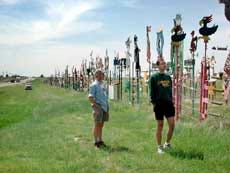
On the way we stopped at just outside Mullinville to gawk in disbelief and wonder at a rich display of roadside political folk art. Stretching along Route 56 for at least a quarter of a mile, it is a standing army of hundreds of colorfully painted sheet-metal sculptures that take equal advantage of the location’s constant high winds and the protections of the First Amendment.
Four rows deep and sometimes 10 feet tall, the politically loaded works of folk art are protected by a barbed wire fence. Many are outrageously funny and provocative. And nearly every sculpture has been outfitted with paddles, blades, propellers and fans of some shape that whir, spin or turn in the wind.
Artistically and politically sophisticated, plastered with hand-printed signs and slogans, the collection amounts to an unpassable poli-sci test for all but the most addicted junkie of politics. They comment on every scandal or controversy of the 1990s, from Waco to Monica’s stained blue dress. They are definitely not recommended as a family tourist attraction.
And poor Geoff. He was as suitably astonished as the rest of us by the prolific and bold expressions of free speech rights. As a New Zealander he had no way to make sense of the messages this whistling wind farm of the right-wing was broadcasting. But neither would 90 percent of all Americans.
The roadside attraction is apparently the mad creation of a very talented but mighty annoyed right-wing metal sculptor named J.T. Liggett. No one was around to ask, and no one was charging admission. And Liggett didn’t answer a phone call placed to the number he proudly advertises.
No matter who is responsible for this sharp slice of Americana, he loves Ron Reagan, Rush Limbaugh and Pat Buchanan. And he hates Bill and Hillary Clinton, all their subordinates and their political allies, not to mention everyone to the left of Charlton Heston and Alan Keyes.
As for tornadoes and those who chase them, he offered no opinions one way or the other.
Nightfall & Stormy Visions
Medicine Lodge, Kansas
9:30 p.m. CDT
Tornado-wise, things are finally starting to look up.
Chris Howell has been sitting at his laptop printing out all kinds of weather data he grabbed off the Internet from the College of DuPage in Illinois.
Brian McNoldy is studying a handful of the brightly colored printouts. CAPE – Convection Available Potential Energy -- is good in western Texas and right where we are. That means there’s going to be lots of energy in the air tomorrow to provide lift for updrafts. Surface winds and upper-level winds are conducive to creating a necessary shear. Dew points are in the mid 60s.
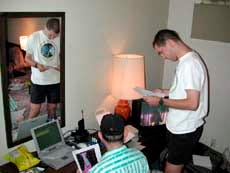
Many good/bad things have to come together to even produce the conditions favorable to produce one of the country’s 1,000 annual tornadoes. Tornadoes are never guaranteed, but Brian says “it’s a vast improvement over today.”
It’s still too soon to know where to go tomorrow. They will look at weather data for several more hours. “This is going to be a hard one,” Brian says.
On one hand, Brian and Chris are cautious and humble about their predictive abilities. But on the other they know from last year’s chasing that they know what they are doing. Last year they were on the scene to watch a tornado be born near Coldwater, Kansas, not far from here.
“We nailed that one,” says Brian. “That was our storm. We were there first and we had pinpointed the location to within five miles. We beat everybody, including the universities.”
As for tomorrow, Chris says things are going to happen right here or to the east -- in eastern Kansas or western Missouri. They won’t drive that far east, however, because the terrain there is not good for chasing. It’s too hilly and there are too many trees. They learned that the hard way in 1998.
“If it happens, and if it happens here,” Chris says, “it’ll be in late afternoon -- 5 or 6 p.m. is when they usually start to happen.” In any case, there’s no rush. They’ll have all day tomorrow to study the data, watch the clouds and feel the atmosphere.
Tornadoes eventually show up somewhere in Kansas in May.
The trick is knowing where and when in time to get there.
(Days 3 and 4 are missing, but nothing happened but a lot of staring into computers, a lot of driving and a lot of eating Middle American fast food. )
Day 5 - May 17
The hunt is on
Leaving Medicine Lodge, Kansas
8:30 a.m. CDT
To steal a sports cliche, it is game day.
This is the day the chasers have waited a year for.
The day of bad weather and thrills Nancy has daydreamed about all winter as she sold Chryslers in Upstate New York.
The day Brian and Chris know will put their meteorological knowledge to the ultimate test.
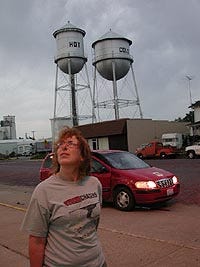
The day vacationing photojournalists Geoff Mackley and Allan Detrich hope will reward them with spectacular images of one of nature’s most fearsome, most potent and most illusive acts of mayhem.
Tornadoes will show up somewhere in Tornado Alley today. Everyone knows it. The TV weather maps have big red warning blobs in the wheaty gut of America. It happens every May.
Tornadoes are the Uncertainty Principle writ large. They come to Tornado Alley by the dozens each spring. It’s a statistical certainty. A sure probability. Where will they strike? North central Kansas? Southeastern Nebraska. The Oklahoma Panhandle? All of them, none of them, and anywhere else.
What day? What county? What little flat town’s tornado siren will die sounding the alarm? Forget it. That’s why the weathermen splatter those blobs across two and half states that make Pennsylvania look like something Ted Turner owns. That’s why chasers have to be very smart and very lucky to get their Great White Tornado.
Today the boredom ends and the excitement begins. The team members are already packing the cars. No long breakfast at the Indian Grill. Warm and cold fronts are colliding over central Nebraska and Kansas. The jet stream is right. Heat and energy to fuel the coming severe thunderstorms have been building up for days.
Late last night Brian and Chris decided that central Nebraska was going to be the place they should be by late this afternoon. All the ingredients for big storms will be here in central Kansas too. But the cloud cover will be too thick. The sun won’t be able to bake the flatlands to sufficient temperatures.
So long Medicine Lodge. We’re driving north and a little east to near the Nebraska-Kansas border, where it’ll be sunny and hot before nature’s hell hits the fan.
“They’ll be some big -time chasing going on today,” promises Brian with big smile.
Heading for Nebraska
U.S. 281 north of Medicine Lodge, Kansas
10:10 a.m.
With eyes to the gray skies we zoom back up U.S. 281 -- a typically flat, straight two- lane Kansas highway – heading north toward Nebraska, retracing yesterday’s fruitless excursion.
Leaving Medicine Lodge, the clouds were almost as thick and threatening as yesterday. It was gray and muggy and already in the low 70s.
A new chaser, Bill Tabor, has joined us. He drove up overnight from Austin, Texas. Tabor had gone on an uneventful chase one day last May with the team after he and Allan connected on the Internet. Tabors’ Isuzu Rodeo is the last car in our well-synchronized, 78-mph procession.
Allan’s Trooper is setting the fast pace for obvious practical reasons. On his dash are the global positioning gizmo and, more importantly, the ever-vigilant Uniden radar detector.
From the rented Chevy minivan where Chris, Brian and Nancy are, Nancy calls on the two-way radio. She says each vehicle should be given a nickname for communications purposes. Allan’s three suggestions -- Rabbit, Lonneybin and Mad Dog, which Bill Tabor preferred to be called -- are rejected in favor of Oz, Base, and Tail.
A few minutes later, as we approach Great Bend, Tabor gets on the radio to pass on the opinion of his storm-hunting buddies back home in Texas. One of his friends favors the Wichita and northern Oklahoma area.
Another likes southern Nebraska along the Kansas border, which is our destination – and which is where the lightest part of the sky is.
Still heading for Nebraska
I-70 north of Medicine Lodge, Kansas
11 a.m. CDT
Hello again Russell, Kansas, boyhood home of Bob Dole.
Goodbye again Russell, Kansas.
We’re now headed east on I-70 toward Salina, Kansas, at a steady 79 mph on cruise control. Before we left the gas station in Great Bend a half-hour ago, Brian used the dusty hood of the Chevy minivan to explain with a map drawn in the dust on the hood just why we are going north.
We need to get on the other side of the warm front that stretches across Kansas from east to west. A cold front angling in from the west like a backward slash on a computer keyboard should spark thunderstorms in southern Nebraska, where conditions are favorable, especially the winds. It should all happen by dinnertime.
Our new flight path is east to Salina on I-70, then straight north on U.S. 81 toward Concordia, Kansas.
We’ve now stopped at the Total truck stop in Bunker Hill, Kansas, where the team hopes to find a phone connection to check the latest weather data on the Internet, using a laptop computer.
Still heading for Nebraska
I-70 north of Medicine Lodge, Kansas
12:28 p.m. CDT
We stop at the Total Truck Stop and Café, in Bunker Hill, Kansas, to hook up to a phone line for access to the Internet and weather reports.
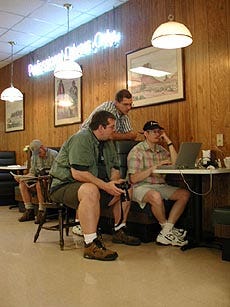
When Brian, Chris and Bill Tabor use a laptop to check the latest weather data, they decide on a more westerly course.
Forget Salina. Forget Concordia.
The new data, especially the loop radar showing the cloud cover parting over western Kansas and Nebraska, convinces them to shift west in their quest for the perfect storm breeding ground.
Brian says everything “looks great for extremely violent weather -- hail, high winds and tornadoes.”
We are now backtracking a mile or two on I-70 through Russell, Kansas, yet again. There we’ll dash straight north on U.S. 281 into the sunny underbelly of Nebraska.
We will be passing very close – maybe within a mile or two -- to the geographical center of the contiguous United States – talk about Middle America.
Still heading for Nebraska
U.S. 281 north of Osborne, Kansas
1:37 p.m. CDT
Osborne and its monogrammed water tower, sidewalks and crazy agri-buildings is 10 miles in our our rear-view mirror.
We’ve gone 192 miles since we didn’t have time for breakfast.
Tornado warning
U.S. 36 near Smith Center, Kansas
2:38 p.m. CDT
We’ve stopped by the side of the road east of Smith Center, Kansas. Bill Tabor has grabbed a strong cellular signal for his laptop on the front seat of he car and he wants to download the latest weather data. Cellular phone signals are tenuous out here in the middle of the countryside.
We are one mile from the geographical center of the contiguous United States.
We’ve been crossing a broad, gently rolling plateau of short green grasses and dirt brown squares. It’s almost as devoid of humans as a photo by Ansel Adams.
Every 20 minutes we fly past an old Kansas lady crouched over the wheel of a Chevy sedan or a farmer lugging a fat water tank in a pickup truck. Oncoming traffic is so light it’s almost nonexistent. The town of Smith Center, “A Town for all Seasons,” has a movie theater on its main street but no stoplights.
As we pass through Smith Center the hot wind is turning the leaves of the trees inside out. Distinct clouds are now hovering on the northwest horizon and bulbous mammatus clouds are hovering right over us. They don’t look particularly ominous but they are sure signs that the atmosphere is unstable and turbulent.
The air feels electric. The sun is starting to make brief appearances. And we find out from Chris, who is also using a laptop, that at 2:30 p.m. a tornado watch was issued for this area by the Storm Prediction Center in Norman, Okla.
Tornado warning
Route 10, Southern Nebraska
3:38 p.m. CDT
We are heading north on Route 10 in southern Nebraska, near Kearney, heading for I-80.
Forty minutes ago we crossed into Nebraska on U.S. 281, whizzing past the farm home of Willa Cather, then crawling through the little town of Red Cloud, with red brick paved streets.
Severe weather warnings are starting to be broadcast on the radio. At 3:36 there was a severe thunderstorm warning six ounties to our west and a tornado warning -- meaning that a tornado has been spotted or is on the ground -- has been issued farther to the west, just across the line in Colorado.
Tornado warning
Kearney, Nebraska
4:05 p.m. CDT
We’re at a gas station at the I-80 exit in Kearney. It’s 74, windy, and just started to rain lightly. Clouds of many shapes, including towering cumulus thunderstorm clouds, are coming out of the west.
A tornado watch has been issued for Wallace, in Lincoln County, a town 90 miles west of our location. There are severe thunderstorm warnings to our west and north. And the tornado watch for central Nebraska and slice of northern Kansas continues until 8 p.m. Central Time.
And there’s also a tornado warning for central and eastern Kansas, which includes Medicine Lodge – our base until this morning – until 9 p.m.
Brian says that these distant warnings will soon be our own local warnings in Kearney. The team is going to get a phone line in a hotel nearby, check weather and radar data, and plot their next moves.
Tornado warning
Kearney, Nebraska
4:35 p.m. CDT
It’s 4:35 p.m. I-80, west of Kearney, Nebraska.
The sun is almost out and there’s no rain. The road is dry, and OZ, BASE and TAIL are speeding along in the fast lane at 85 mph straight into the coming storm system.
The team did not stop at a motel for a phone line after all. Bill Tabor’s laptop -- which he keeps facing him on his passenger seat as he drives -- showed what Chris said is a profile of a tornado cell about 15 miles to west/northwest of Kearney.
It is hidden behind a line of rain squalls. We can see that storm system to our right as we drive. We’re trying to get on its southeast side, which is the safest position to be in when you’re chasing tornadoes.
The storm cells
Lexington, Nebraska
5:28 p.m. CDT
We’re just at the Lexington exit on I-80 west of Kearney -- we’re are in the middle of two gigantic storm cells and it has started to blow very hard as we’re driving.
Now we’re seeing a gigantic dust storm, it’s lifting a bunch of dirt from a field into the air. And we’re watching very tall cumulus clouds that may contain the start of tornadoes.
We’re surrounded by very nasty storms and its blowing 45 - 50 miles an hour as we roll down I-80 west now to circle around the cells in hopes of chasing a tornado. It’s just starting to hit.
Lexington, Nebraska
5:50 p.m. CDT
We’re 10 miles west of our last position still between the two storm cells. The wind has dropped a little. It’s relatively quiet in this zone … it’s raining a little and there was all kinds of hail here. There’s hail the size of a little baby chocolate Easter eggs scattered in the grass. We can see bad weather north, west and east of us. South, there’s a gap of big white clouds and blue skies. It’s not raining at all right now, but it’s three hours to nightfall and there’s still plenty of ugly weather coming. The team is sorting out the next move, checking the radar reports.
Outskirts of North Platte, Nebraska
6:33 p.m. CDT
We’re leaving the nice weather hole, watching a wall of low, charcoal gray clouds approach … we’re driving right at them, heading to North Platte, Nebraska. We’re rolling along at 85 miles looking to get off I-80 to head north. We’re passing North Platte. There’s some lightning and, under the lid of gray clouds you can see a band of clear air. I’m now driving the team’s OZ car with Allan in the back seat and Geoff in the front passenger seat. When we pass under one of the charcoal gray clouds the wind picks up and the temperature drops … and then we’re through it and things become milder again on the other side. We’re taking the next exit now to head out on Route 83.
North of North Platte, Nebraska
7:05 p.m. CDT
We’re on I-83 heading north from North Platte and there’s lightning all over the place, this is a very powerful storm system that we’re heading under.
The team’s decided there’s a cell ahead that we can reach ... there’s lightning from cloud to cloud and cloud to ground and now we see there’s an immense storm cell behind us. I’m trying to see it the rearview mirror better.
It’s huge. The team’s slowing down now. It’s all black from ground to sky here and there’s no light under this --- strangely, it’s not dark --- but there’s no hint of sunlight. We’re on a hill here and we’re coming to a stop now and the storm cell behind us is simply immense, it’s like a giant wave out there. I’m getting out of the car for a better look ...
North of North Platte, Nebraska
7:20 p.m. CDT
The huge wave of dark clouds was what is called a gust front coming through, the temperature fell to 40 degrees outside as it rolled over us – a bitter cold. We crouched in the cars with the heaters on full blast trying to warm up. We’re on a hilltop with wheat-colored grass all around and the team’s looking at their radar screens now. They say there’s another cell farther to the north that we can catch. We heading out now …
As the storm turns
North of North Platte, Nebraska
8:04 p.m. CDT
We are watching an incredible bunch of lighting flashes about 30 miles away. We are still literally under a large black cloud that, according to the radar data pulled down from the Internet using cell phones, is a mesocyclonic cell, which means basically that it’s rotating.
And if it’s rotating, it’s potentially able to create a tornado. There is a chance, but it’s not a real powerful cell. It’s bitter cold still. It’s amazingly cold. It can’t be more than 40 degrees now.
From right to left as far as I can see is a gigantic, charcoal black cloud that fills 160 degrees around me. And actually, the cloud is growing as we look at it. It’s oozing and climbing higher. It’s pretty cool.
No twister tonight
Gothenburg, Nebraska
9:29 p.m. CDT
The big black cloud just sort of fizzled out. It took off like a giant flying wing to the east, and the decision was made not to pursue it because it was not going to spawn any tornadoes.
After 11 hours of storm chasing, we stopped at the Homestead Cafe in Gothenburg, Neb. We’re refueling ourselves 318 miles north of where we started the day in Medicine Lodge, Kansas. It looks like steak for the fourth night in a row here in the heart of Beef Country – an 8 oz. sirloin, salad bar, choice of potato and coffee or tea for $9.50.
After dinner, we’ll drive as far east as we can along I-80, perhaps all the way into Missouri, to get ready for tomorrow’s hunt.
Tornado survivors
Gothenburg, Nebraska
11:33 p.m. CDT
We’ve abandoned plans to head for Missouri and instead will stay at the Gothenburg Super 8 motel. Also staying here: The Stickelman family of Brady, Neb. Their home and those of three other families in and around Brady were destroyed by a quarter-mile wide twister around 4 p.m. CDT.
No one was injured. We saw the storm on radar but couldn’t get to it safely. We’ll head east tomorrow.
And the steak was terrible.
Day 6 - May 18
The day after
Homestead Cafe, Gothenburg, Nebraska
11:30 a.m. CDT
It’s about 45 degrees -- windy and rotten The chase is officially over, at least for this week. The same storm system that destroyed Brad Stickelman’s home near Brady, Neb., yesterday afternoon and generated 27 severe thunderstorm and tornado warnings across Nebraska yesterday is going to hit Missouri, Iowa, Indiana and Illinois later today.
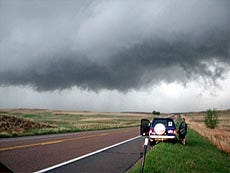
We could have driven east to these states in time to continue the chase if we had left about three hours ago.
Brian says that it is too far even if they didn’t have to go back to Wichita tomorrow to meet six other members of the MESO team.
They’ll be joining Chris, Brian, Geoff and Nancy for another full week of chasing in Tornado Alley.
After breakfast, we’re going out to what’s left of Stickelman’s home near Brady, about 20 minutes away, after a tornado destroyed it yesterday. It’s not for rubbernecking reasons, but because the team can learn about yesterday’s storms. By seeing the damage to a stout brick house, they can estimate the strength of the twister that hit it.
The Fujita Scale, the standard way of measuring the power of a tornado, is a damage scale. The only way you can measure a tornado is to see what man-made things it destroys.
Surveying the damage
Brady, Nebraska
2 p.m. CDT
At what’s left of Brad and Janine Stickelman’s brick house, the path of the yesterday’s malevolent tornado is easy to track. It came from the southeast over some low hills, ripping down power lines before slicing across a farmer’s field as flat as a desktop.
Lifting enough topsoil to make a quarter-mile brown swath in the green seedlings, it flipped a 300-foot-long sprinkler like a toy, snapping it into several pieces.
It bore down on the Stickelman place like a giant weed whacker, shredding the oasis of cottonwoods and locusts around the house. As the Stickelmans hid in the basement, it yanked off their roof, blew out their windows and reduced their sheds and outer buildings to misshapen balls of heavy-gauge tin foil.
It tore out some more power lines for good measure, then twirled off at 40 mph toward its rendezvous with the the woodframed home of Sue Taylor five miles west.
Chris and Brian, investigated the scene with Allan, Geoff, Nancy and Bill Tabor, the Texan who was still with us. As workmen in a pickup truck dragged the bushy top of a severed cottonwood down the road, they estimated that it was an F-1 on the Fujita Scale. Small but impressive enough for the Stickelmans.
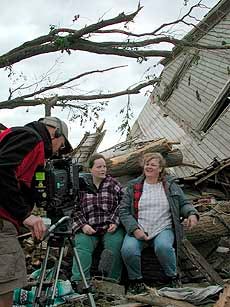
When the tornado made its surprise visit to Sue Taylor’s home near the town of Maxwell, she was standing in her front door with her daughter Heather, 22. The only thing Heather had time to do was close her eyes.
In the roaring maelstrom of dirt and smashed furniture and household goods, she felt herself being thrown all over the place. When everything stopped she and her mother found themselves with a collapsed house on top of them.
Heather had scratches on her face and bruises and cuts on her legs. Her mother had a small gash near her eye. Her mother’s menagerie of farm animals and pets survived, except for Snowball. The goose was found lying dead in a pile of rubble that included five or six smashed automobiles.
When we arrived, a dozen volunteers from the Salvation Army and elsewhere were towing cars away, using a chainsaw to make sense of the downed tree limbs and trying to free Klondike the goose from under a six-foot-tall layer cake of house parts.
Sue and Heather Taylor were retelling their 60 seconds of horror to the local media -- and anyone else who came by -- in great and eloquent detail.
Sue Taylor had no medical or household insurance. The Salvation Army seemed to have everything in hand. But the team, which is naturally sensitive to the victims of tornadoes, decided to give her a check for $200 from the MESO account. Bill Tabor and Geoff each kicked in $40 in cash.
Geoff spent nearly an hour interviewing the Taylors and videoing the extrication of Klondike. He hopes to sell the footage to one of three TV documentary companies he knows of that are looking for “survivor’s stories.”
The Taylors’ stories had all the right elements, he said, speaking with the confidence that comes from having great experience in human disasters of all kinds:
— An amazing escape.
— Their ability and willingness to explain it to people.
— Plus her animals survived and people are into that, said Geoff.
The only missing ingredient, he said, was footage of an actual tornado.
But getting good tornado footage is why he is vacationing in Tornado Alley in the first place. He and the MESO team -- with six days and 2,450 miles of chasing under their hoods -- still have another whole week to capture their twister.