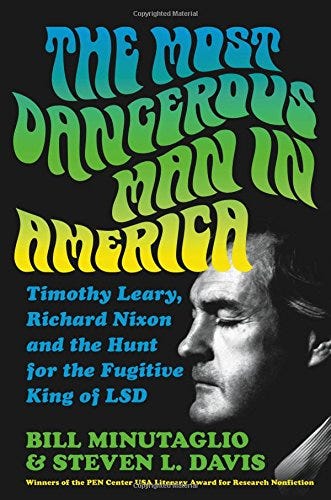
When he died on May 31, 1996, Doctor Leary was no longer the Most Dangerous Man in America. But in 1980 he was still having fun and making news when I interviewed him on his lawn in Beverly Hills.
I’m one of the funniest, nicest guys who’s ever been sent down to this planet.
-- Timothy Leary, 1980
Timothy Leary sits, guru-like, under a eucalyptus tree on the grass in front of his modest apartment on a quiet corner of Beverly Hills. Wind chimes tinkle. Now and then a Mercedes purrs past or one of Leary’s elderly neighbors walks by. In the distance, an emergency siren wails.
It is 1980. California is still a paradise over-populated by young, ambitious and happy migrants from Back East and America’s Pied Piper of irresponsible drug use has just turned 60.
He’s been doing “stand-up philosophy” routines in clubs and is still having so much boisterous fun with psychedelic drugs and his young wife that he’d been visited recently in the early morning by Beverly Hills police.
As the stay-at-home dad of a six-year-old, he spends many afternoons in the street teaching immigrant Iranian kids how to play baseball. Along with my yellow legal tablet of questions and my tape recorder, I arrive with a terrible headache.
Based on his evil media stereotype, his imprisonment on minor marijuana charges, his subsequent prison break and years living on the run in Europe as an international fugitive, I expect to find a cranky, angry old coot filled with hate for America, its culture and all the straight people like me in it.
In fact, I find one of the most memorable – and likable – persons I’ve ever met. Leary is good-natured, charming, full of energy, devoutly optimistic and beaming with stereotype-busting opinions about individual freedom, government, media, evolution, sex, Hollywood, biology, Muslims and a bigger, better future for human beings, his favorite species.
Q&A
Q: What kind of people keep in contact with you?
LEARY: I don’t give out my address to people, but you should see my mail. Fifty percent of it is conventional — serious scientists doing research. The other half is Jesus and messiahs and UFOs, etc. I’m sure it’s all right, but you can imagine what kind of letters I get.
Q: Do you keep in contact with people from the ‘60s and ‘70s?
LEARY: Everyone keeps in touch. Everybody knows where everyone else is scanning on the radar.
Q: I saw your show at Huntington Beach.
LEARY: What did you think?
Q: I liked it. I liked it. I’m a libertarian politically, so...
LEARY: Me too.
Q: I’m supposed to be critical... (a reddish brown cat comes along) …
LEARY: That’s a very old cat, very gentle -- 105 years old. It’s amazing how he always goes to where the real estate paper is.
Q: The story I am going to do is from a Middle-American point of view – “Whatever happened to Tim Leary?” What would be your answer to “Whatever happened to Timothy Leary -- that drug guru, that drug maniac of the ‘60s”? What have you been doing?
LEARY: I’m doing what I’ve always done -- writing and lecturing and being involved with media. I do four or five TV shows a month, a syndicated radio slot. I’m doing what I always do -- defending the American conservative-libertarian way of life. Encouraging individuality and disrespect for authority and trying to keep the government out of our lives, like every red-white-and-blue American, heh, heh, heh.
Q: The lectures you’ve been doing -- how many?
LEARY: (His phone rings.) I do about 40 a year -- half in colleges.
Q: How are you received -- pretty well?
LEARY: The people who are going to pay $6.50 to come to see me obviously like me. I call it “stand-up philosophy.”
Q: You laced your routine with a lot of drug references. That’s the obvious part of your message, but is it all of it?
LEARY: I’d say 15 percent of it was drugs. I emphasized drugs more than I usually do. I spend much more time on space colonization and genetic research and the breakthroughs in physics. And on new drugs -- the new neurotransmitters that are not street drugs.
I try to demystify drugs by saying that the way society adapts to technology is always the same way. For the first generation it’s taboo and it’s shocking and its mysterious and it’s misused and it’s diabolical. But when it cools down, people learn to use the new technology more precisely and effectively. They try to put drugs into context.
Q: How important are drugs to you in your life? Did the first time you took LSD cause a change in you?
LEARY: I was a hotshot Harvard prof who had devoted my entire professional life to finding new ways of freeing human beings from their locks and inner chains. So when I first stumbled on to LSD, I wasn’t the average backdoor lawyer or politician or business person. It was like a biologist who stumbled on the microscope or an astronomer who suddenly hears about the telescope.
So my reaction was that it was exactly the tool I was looking for all my life to give humanity a way of looooooosening up their thinking and re-imprinting and understanding the brain and moving consciousness outward. That was my profession.
I had written classic textbooks and I was a distinguished Harvard professor. I’m a philosopher. I’m philosophizing all the time. I can’t help it. Naturally, drugs being tools to focus your brain, they were my meat and potatoes.
Q: But when you were in the army and before the LSD experiments -- in other words, it didn’t change you, the LSD experiments?
LEARY: Yes. I was always the 24-hour philosopher and I was always an extremely avant-garde psychologist. I was one of the 12 psychologists who in the ‘50s brought about the tremendous revolution that we now call “The Third Force” -- do-it-yourself psychiatry.
I’d say the greatest revolution was one in the 1950s by Benjamin Spock, by Carl Rogers, Rollo May, Eric Fromm. We literally were wrenching the mind away from the psychiatrists and the Pavlovians and giving the mind back to the individual. That was a tremendous revolution. It leads, of course, to all sorts of silliness and kookiness and sects and gurus, but that’s all right.
The kookiest sects today were not as kooky as orthodox psychoanalysis was back then, believe me, heh, heh. I was an avant-garde psychologist, but there wasn’t this social pressure. Sure there was peer pressure.
Some psychiatrists were all trying to put us in jail in the ‘50s for doing group therapy. To psychiatrists in the ‘50s, the idea of a group of neurotics sitting around talking about their problems would be like a bunch of surgery patients performing operations on each other. It didn’t threaten society in general the way drugs did.
Q: What is the best facet of the drug revolution?
LEARY: Encouraging intelligent, disciplined, responsible use of drugs. Of course nobody listened. If I had been more effective ... The CIA had $25 million to support their LSD research, which was the secret, deliberate messing-up of people’s minds. Mine was open and public attempts to free people’s minds.
Now if I had $25 million, then, heh, heh, heh, imagine what we would have done, in the way of correct packaging and labeling and cautionary labels, heh, heh, heh, heh, heh.
Q: Are mind-expanding drugs for everyone? Should they be mass produced? Mass marketed, mass advertised?
LEARY: When you talk about brain-activating drugs, you’re talking about a wide range of substances that transport yourself around in your own brain. And that range is as wide as from kiddy cars to rocket engines.
The powerful drugs are like rocket engines and both common sense and public law should prevent inexperienced people from jumping into a rocket or jet airplane and taking off from Wilshire Boulevard or landing it in Times Square.
Drugs are very similar, because you have to include liquor. I’m a total libertarian. I think government has no right interfering in the private lives or personal behavior of people as long as they don’t physically hurt anyone else.
I don’t think the government can take the place of intelligent parent-child relationships. You can’t have the police bust your kids because of their sexual practices or their drug practices or something you don’t approve of.
Q: Do you think you’ve been treated fairly by the press over the years?
LEARY: I don’t believe in the concept of fairness or justice.
Q: Do you think they’ve exaggerated you or built you into someone you weren’t or anything like that?
LEARY: Yes. That’s the function of the press….
Q: Can you be taken seriously about anything now, because of your image?
LEARY: Media has been my obsession for the last 20 years. Media is applied intelligence. When I send out a signal -- first of all, you have to be pretty good to get a signal out. You have to be somehow good enough to have the newspaper print it or have the radio station broadcast it.
And one of the laws of communication is that the more intelligent and shockingly precisely futuristic you are, the fewer people are going to get it. If you say exactly what everyone on Main Street wants to hear now, that’s Reagan and Carter, heh, heh.
As soon as you start getting more intelligent, more scientific, more futuristic, you’re going to start losing audiences. And you know Einstein was never a best seller, never had a prime-time show.
Q: Do you regret any of the trouble you’ve started?
LEARY: I’m extremely pleased with the amount of trouble I’ve been able to stir up. I’m still controversial after 20 years, see. Eldridge Cleaver isn’t controversial. I’m right on the edge of society’s nerve endings. Of course, society is often most nervous about the next step that’s going to change everything.
Q: What’s the next step. Space migration? Cable TV? What do you hope will happen in the 1980s?
LEARY: Europe is going to become slowly communized. Europeans are making deals behind our backs so fast that NATO’s going to collapse. Only in North America will the freedom impulse not only continue but grow.
The place to be in the ‘80s is the U.S., particularly in the Sun Belt. The West especially is much more advanced that the East -- in terms of everything. In terms of economics, we’re not going to have the kind of depression they’re going to have in the East, because the East is still bogged down in the old techniques of both government and manufacturing and industry. Whereas the Sun Belt has opened up to the new industries, which are electronic, neurological, computers, aerospace, entertainment, media.
Q: Is the any hope for the people in the East?
LEARY: Yeah, migrate, heh, heh, heh, heh. Get out here fast. California is pyramiding. Get out here fast.
Q: I have a terrible time convincing anyone Back East that there are virtues to Los Angeles. They think it’s just weirdos and earthquakes and serial murders. The media don’t portray this part of the country as a place to come to.
LEARY: I know. They do that to everything.... but that’s always been true of migration. The Establishment always tries to do that. They used to say that you can’t go across the Atlantic or you’ll fall off the end of the world or the dragons will get you. Or if you want to migrate from Greece to Rome, the Romans are barbarians.
They’ve always warned people ... because the Western frontier has always been wilder, because you get the individualists, you get the risk takers, you get the high-stake visionaries. The people who are on the run. The Western frontier for the last 2,000 or 3,000 years has always been wilder and woollier. Each wave of the future moves a little farther and farther west.
When the first immigrants came over to the United States the Catholic priests deliberately kept their flocks around them in New York and Boston and Philly. They didn’t want them cutting out and getting to California.
I’m amused when I watch the Eastern press. Every time they mention California, they shake their head, heh, heh, heh. But actually the homicide rate is much higher in the East than in L.A., isn’t it?
Q: I don’t know if that is true. I think L.A. is a good town because of the people who are here. They’re the hustlers and the people seeking dreams. People who want to do something more than sit in Pennsylvania or Ohio.
LEARY: They can make fun of California as much as they want. Time magazine, Newsweek magazine and the New York Times, Washington Post, all the syndicates and so forth, they’re all Eastern.
The way they treat Western writers …. The whole Western school of writers is entirely different from the East Coast. The East Coast is either Southern alcoholic or Jewish family or New England WASP -- that’s John Cheever, Episcopalian, adultery and so forth -- it’s a European orientation.
The Eastern literary people have flatly said there are no great American writers, but there is a California school of writing that is entirely different and, of course, isn’t even accepted by the East Coast literary Establishment. It’s always been that way. (He speaks in a quiet voice, slow, not crazy or antic.)
The West Coast writing is much more optimistic. It’s funnier. It’s transcendental. It’s Ken Keasy and it’s Harold Robbins and it’s Henry Miller and it’s Aldous Huxley and it’s science-fiction people and it’s Ambrose Bierce and it’s Chandler.
There’s an enormous body of literature, which to me represents the best of the America tradition – nose-thumbing at authority, futuristic, Jack London! Do you know he was writing science-fiction stories 80 years ago? Ironically enough, California writers are much more popular in Europe than they are on the East Coast, except for Henry Miller.
Q: Charles Bukowski?
LEARY: Bukowski’s another.
Q: Who are “the ecological Puritans”?
LEARY: Jane Fonda and Ralph Nader. They represent the absolute worst – they are moralistic, puritanical, virtuous. They are anti-scientific, anti-technological. They’re close-minded. And they’re breeding fear, almost a primitive, barbaric generation of terror. They are the classic -- I’ve got a new column in defense of the big American car. We’re an endangered species, like the low-mileage buffalo, the gas-guzzling whooping crane and the high-octane eagle, heh, heh.
Q: What kind of car do you drive?
LEARY: A Mercedes, heh, heh. I want to get a bumper sticker that says, “Buy American,” but my wife ... heh, heh. (An old-timer is passing by on the sidewalk.) Hi. How are you doing? (Leary makes a joke -- something about Sherwood Forest and Robin Hood.)
Q: Does that guy know who you are?
LEARY: No. The paradox is, everyone who knows me, loves me. That’s the paradox. I’m really a wonderful guy. I’m out here. I’m the only father in this neighborhood. There are no fathers for many reasons. There are a lot of Iranians. I’m the one who’s out all the time teaching them baseball. I’m the only father that’s around at all. I’ve got about 20 kids here.
Q: You have a six-year-old kid, right?
LEARY: Yeah. Yeah. So I’m out here all the time. It’s not a heavy, shades-down, shoot-‘em-up drug gallery. I do a lot of my interviews out here. They all love me. To know me is to love me, personally.
Q: That’s the impression I got from watching your stand-up philosophy show. You’re a friendly guy. You’re not a bitter man.
LEARY: I think I’m the happiest man who ever lived.
Q: You still are?
LEARY: Yeah.
Q: The reason I keep grabbing my neck is I’ve got a headache.
LEARY: You need another beer?
Q: No. No.
LEARY: Want an aspirin?
Q: I just grabbed about three of them two hours ago. Um .... The political scene ....
LEARY: (He rolls his eyes). The overwhelming statistic is that 70 percent of Americans are totally turned off by politics.
Q: Why do you think that is?
LEARY: Well, for many reasons. One is that America is ungovernable. It’s simply too big and diverse a country. America’s like the British Commonwealth was 50 years ago.
The difference between Maine and Arizona or between Washington and Mississippi is as great as between England and South Africa and India and Canada. I’m very much in favor of regional secession, so that America could become a commonwealth or a confederation. The best run country in the world is Switzerland.
Q: You lived there a while didn’t you?
LEARY: I was in exile there for 18 months. Switzerland is a confederation of independent cantons. It’s great. And they give very few rights to the federal government.
Q: Do you think victimless crime laws will ever be repealed or have their penalties reduced?
LEARY: Victimless crime should be local. If there are some people who live in a neighborhood and they don’t want homosexual teachers and they don’t want liquor and they don’t want cigarettes and they don’t want business and they don’t want marijuana, then let them have local option.
So in Camden, New Jersey, they don’t want anything, heh, heh. On the other hand, maybe Newark wants beer, liquor, marijuana, but doesn’t want gays. All right, there’s got to be local options, because there’s 43 million people smoking marijuana.
The only solution is local option, then nobody’s bothering anyone else. Sex education in schools -- I sympathize with parents who don’t want their children brought up by liberal teachers. If you don’t want your children taught by liberal teachers, then move to a different place.
There’s this illusion of uniformity and we should all be one, we should all agree. You’re going to see more of that in the ‘80s. You’re going to see, paradoxically, what you saw happen in the ‘70s.
Some cities and towns are going to become increasingly liberal, like San Francisco. And they’re already starting “Scopes Trials” and throwing out books in some place in Tennessee. So that’s fine. No big deal. Where you are determines who you are.
Geography is the key to the kind of life you lead. People should be encouraged to move so they surround themselves with like-minded people, so they don’t get on each other’s nerves.
Q: Do you think people are more or less free today than they were 100 years ago?
LEARY: Americans?
Q: Yeah.
LEARY: Oh, I think were much freer today because we have many, many more options now. What choices of freedom were there 100 years ago -- liquor? You could run off -- heh, heh, heh -- with a jazz band. There weren’t many options.
The increasing boom in technology that is made available to consumers has given us an enormous range of freedoms to be able to come and go as we want. Think of the freedom of literature we have now. Thirty years ago they wouldn’t let Henry Miller’s books be published.
Q: Do you think there are people today still being persecuted for their ideas? (former U.S. Attorney General) Ramsey Clark, I guess, would be an example of someone. He’s getting shit from everybody about the Iranian hostages.
LEARY: I don’t think he’s getting persecuted. He ran out and said he was going to be the quarterback for the anti-Shah team. Well, naturally, you immediately get on your back Henry Kissinger and Nelson Rockefeller and Time magazine.
I don’t think he’s getting persecuted. He’s getting exactly what he wanted, and I don’t think he’s worried and I think he’s done us all a great favor. He’s made everyone think, “Does an American citizen have a right to go to Iran and talk to foreigners?”
I’ve never been a great admirer of Clark’s. I personally think the ayatollah is a horrible person and I think Hanoi Jane -- I was very much against the Vietnam war, but I had no illusions about Jane Fonda. I knew the Hanoi government was much worse than the Saigon government.
But it wasn’t our business to get in involved in the fight. I never had illusions that I wouldn’t have lasted one day in Hanoi but I could have made a lot of money in Saigon.
Q: How did you live in Algeria then?
LEARY: It wasn’t easy. I’m very familiar with Muslim Puritanism and fanaticism and the idea that it’s all right to kill you if you don’t do what they say, heh, heh – Arabs are not nice people. Over here, if they’re smart enough to come over here, they’re like the rest of us. But, boy, I would no more go to live in an Arab country —whew! — because I know from experience.
Q: You said somewhere that “Everything I do is to increase individual freedom, responsibility and choice.” What are greatest impediments to that today in America?
LEARY: Well, old people. I went around to several polling booths to see what was going on. They’re all run by old people -- mainly old women. Naturally, they’ve always been impediments to change.
A person who is 70 years old now was born in 1910. Whew! Figure how frightening the future must be to them now. I’m not complaining about this. These are natural genetic brakes on change that are necessary. Nothing happens until the old guard dies out.
It’s going to happen that way in Iran. It’s going to happen that way in China. It’s going to happen that way in Russia. It’s going to happen that way over here. So the impediments to change are always adulthood. By definition, the word “adult” means one who has stopped changing. So the greatest impediment to change is grownups. (The brown cat comes snooping around again.)
Q: In your stand-up ‘lecture’ you made a lot of references to male-macho, Darwinian stuff. Is this a sudden feminist influence on you? (An elderly woman comes along the sidewalk and says hello. Leary tells her, “Good luck, good luck.”)
LEARY: Feminism to me is aggressive women trying to act like terrible men. My studies -- and from 35 years of being a psychologist, and from all the scientific books I’ve read at every level of science -- have made me feel that women are simply smarter than men.
At the early origins of life, the male was the viral infection that the female allowed to come in and change her DNA because there are all these advantages to the egg to have men running around doing all the errands.
Every intelligent man realizes that women are smarter than men. Who ends up with all the money? Who lives longest? It’s effective biological intelligence. Week after week, month after month, I put out scientifically based and humorously effective propaganda called “the Egg Intelligence and Wisdom.”
I’ve done more of it recently because as I’ve studied Western science and Western philosophy recently, I see that all the mistakes are because it’s a male point of view. Competition between males and fighting and all of that.
So, obviously, the male macho ... (He stops abruptly, as though he’s run out of thought.) Darwin struggled and struggled with all-male power. It was all male. He looked for female selectivity. It was a period in England when women couldn’t vote. It was natural that it was all masculine.
Q: Were you a teaching professor at Harvard?
LEARY: No. I’ve never been a teacher. I’m not good at teaching. I’m not good at passing on canned knowledge. I can’t pass on canned knowledge or go to meetings. I break out in a sweat.
Q: You’ve said people are 99 percent genetically programmed and the idea of choice and free will is a lie. Are some people doomed to a life in Peoria?
LEARY: Yeah. There’s no question. I don’t even talk about individuals. I see human beings always as being part of gene pool clouds. As a matter of fact, the most sophisticated businesses today don’t believe an electron is a fast-moving billiard ball. An electron is a cloud – a cloud of possibilities.
You watch birds going south or north and humans are the same way. Yes. I believe there’s a migratory outcast, probably around 7 to 10 percent of any gene pool -- salmon or a flock of gulls.
There have been studies of migratory patterns of animals. Whereas 90 percent of all salmon go back to same spawning pool, 10 percent don’t. It’s that 10 percent that everything depends on if the spawning pool dries up or if it’s taken over by narcotics agents.
DNA never puts all her eggs in one basket. So those who stay in Peoria belong to the 90 percent and God bless them. You need the mass, you need the swarm, you need the collectivity, and they’re playing their role. In their heart, they know they’re right.
Q: Then what is the danger? To let them call all the shots? Or is there a danger?
LEARY: No. Let them call the shots in Peoria, heh, heh. The danger is, don’t go back to Peoria and try to set up a --you know, I could never be Timothy Leary in Peoria, sitting on my lawn and doing this.
The key to everything -- and this includes galaxies down to electrons and protons -- is to find the right niche that will give you the energy to make the connection and don’t get involved in niches that are not genetically geared to you. And don’t try to change the home ground. You’ll never change it.
Five thousand years from now they’ll come back in spaceships and the ayatollahs will still be fighting the Iraqis. That’s what they love to. They’ll be doing it more sophisticatedly, obviously, but they’ll still be doing it. You never want to change anyone on the spot. The only place real change takes place is on the frontier.
Q: And space is the future? The American future?
LEARY: There is a danger that America will become like the Vikings. The Russians make two visits to space and we haven’t done anything since 1975. I see it as one of my innate functions to be a truth carrier now and then and send out a signal to the 10 percent. I never speak to more than 10 percent -- those who genetically reverberate to my message, which is “move, change.” The trick is to keep moving.
Q: Is it inevitable that the moving is always good?
LEARY: To the individual or the species? The male ejaculates 500 million sperms. Usually no good comes of any of them. Maybe four or five times in your life one of them hits. One little sperm that gets the egg machinery all excited….
Q: What’s the most important message you’re trying to impart?
LEARY: The evolutionary process is intelligent, it is benign and it’s evolving and it’s continuing. The more you understand evolution, the wiser you are, the funnier you are, the happier you are and the more secure you are.
All the institutions try to stop evolution. The Ayatollah’s problem is that he doesn’t want anything to change from what it was 100 years ago. (Another old guy walks by, then Leary’s son Jack comes along.) I wish more Americans would understand me and my philosophy, because they would feel a lot better.
America is the greatest country that ever lived. The young people are the greatest young people to ever hang around. The whole experiment has been a tremendous success -- the whole planet. The more people who understand my philosophy, the happier they’ll be, the nicer, the more friendly, the more hopeful, the more confidence they’ll have, heh, heh, heh. I wish more people understood. That’ll take time.
Q: Do you think they are capable of understanding or just don’t hear it?
LEARY: I give out vibrations of cheerful, reckless, arrogant enthusiasm. That puts 90 percent of the people off, because the whole culture is Judeo-Christian and it is based on the vale of tears and you’re supposed to suffer.
Professor Leary sees the future
A week or so earlier, at a standup philosophy routine in Laguna Beach, the audience is disproportionately composed of yahoos. Males mostly.
Leary tells them he loves the beaches of California. He says he has had a terrible time with the press and talks about his recent run-in with the Beverly Hills police.
Bad PR -- that’s why he ended up in prison, he tells the yahoos. Bad PR. Image-damaging AP wire dispatches – “Police arrest Tim Leary, dread king of acid.”
The police said my wife and I were fighting, Leary says. In fact, he says, “My wife and I were in the bedroom. I was taking an incredibly strong aphrodisiac -- not fighting. Suddenly, the Beverly Hills police crash in through the front door. I’m somewhere near the star Sirius….”
He tells his youthful audience the ‘70s was “ ‘The Me Generation” and the ‘80s will be ‘The Media Generation.’ ” He tells them in the ‘60s we took the human body away from the American Medical Association and said ‘You’re responsible for it – you’re responsible for your own body. You’ve gotta decide you have to diet it, medicine it, etc.’
“The same thing is true for the human brain,” he says. “For centuries the brain and human conscious has been the provenance of the ministers and priests and psychiatrists. The psychiatrists.
“Come on, don’t make me laugh. We wrenched the power and control of the human body and the human brain away from this priesthood of experts with their diplomas and got it back to where it’s got to belong, to individual human beings....”
Leary tells the crowd you have to be responsible and learn from your mistakes. Then he tells them about the future.
“Just as we took the body and the brain from the authorities in the ‘60s and ‘70s, in the ‘80s we’re going to take the media away from ABC/NBC and everyone’s going to get in the media.
“You can build yourself a satellite dish. It’ll cost you $20,000, but you can bootleg one for $300. So break the law. Get yourself a satellite dish so you’ll have 1,000 shows coming in.
“Get yourself a little transistor. We’ll be building up cable TV and small networks and we’ll wrench power away from the big establishments, just as we did with drugs and with medicines in our body.”
Leary tells his audience that the police are already into media and cinematography. They taped congressmen for the ABSCAM sting and the Beverly Hills cops carried cameras when they raided him at midnight.
“The police broke into our building and they had flash bulbs and a video camera. Things went in and out of focus -- we were naked. Oh well, you can’t win them all.”
Leary is good-natured about the raid, even though they videotaped him and his wife naked as they took them to jail. Beverly Hills has “the cutest little jail -- Spanish stucco and tile,” he says. But he says it was “an insult to my pride when they threw me in the drunk pen. I call that police brutality.”
Leary is much, much tougher on Hollywood.
“The Hollywood system is really a company town, where everyone’s afraid. It’s run by crooks. It’s run by people who deliberately make these movies that make you feel bad, that make you feel helpless. They never give you a movie about good-looking men and women getting together, and getting smarter and moving and doing and getting something better. Alcoholic, rum-dum, Hemmingway, Fitzgerald, you know, ‘Postman Rings Twice’ repeats and repeats and repeats… It’s a loser industry for losers.”
The man who warns people to never become an adult calls the term “overdose” the sleaziest of adult terms: “Watch out. The ‘overdose’ will get you.” But “overdose” isn’t the problem, he says: “99.99 percent of all people who’ve ever lived on this planet have died of an under-dose.”
After telling his audience that “I’m one of the funniest, nicest guys who’ve ever been sent down to this planet,” the most dangerous man in America leaves them with a final bit of advice.
“I wish that you, when your moment of truth comes, can add up your life and come to the conclusion that it’s been one jammed and crammed with excitement and change and growth and hope and positive, high-velocity better fusions and funnier intelligence. Onward and upward, we’ll meet aloft.”
A link to a look at Leary’s standup routine, circa 1984.
His mother was a teacher and his father a dentist. He attended West Point, joined the Army, and earned an undergraduate psychology degree at the University of Alabama while in the service. Next he earned a master’s degree from Washington State University and a doctorate in psychology from the University of California at Berkeley.
In 1959, Leary joined the faculty of Harvard University. There, he met professor Richard Alpert and began a series of controlled experiments with psychedelic drugs. Four years later they were fired for using undergraduate students in the tests.
They retired to Millbrook Estate, a 63-room mansion in upstate New York. People like William Burroughs, Abbie Hoffman, Jack Kerouac, Aldous Huxley and Allen Ginsberg came and went, all united by a desire to experience better living through chemistry.
In 1970 he escaped from the California Men’s Colony at San Luis Obispo, where he was serving a 10-year sentence for possession of two marijuana joints. His bust-out was aided by the Weather Underground and his third wife, Rosemary. He and she roamed from country to country.
In Algeria, they took stayed with Eldridge Cleaver, who ultimately kidnapped his guest couple after a political disagreement. The Learys escaped and fled to Switzerland.
In 1973, at the Kabul airport in Afghanistan, Timothy Leary was arrested by agents from the U.S. Drug Enforcement Administration. Extradited to the United States, he was sent to Folsom prison near Sacramento.
After he was paroled in 1976 Leary’s life turned to lecture tours, stand-up comedy, writing books, cyberspace and the Hollywood party scene. He launched a much-ridiculed lecture tour in 1982 with Watergate villain G. Gordon Liddy. He learned of his prostate cancer in January 1995 and celebrated his remaining lifetime through his own web site. He died at age 75 in Beverly Hills on May 31, 1996.