
First Amendment Writes
During the 1980s I edited the letters sent to the LA Times' Sunday Calendar. I did my best to entertain, inform and please 1.1 million readers. I had fun. Made trouble. Never sent to Journalism Jail.

For almost nine years I spent a lot my time opening, choosing, verifying, editing, laying out and headlining the 50 or so typed, scrawled or crayoned letters we received each week at the LA Times’ Sunday Calendar arts & entertainment section.
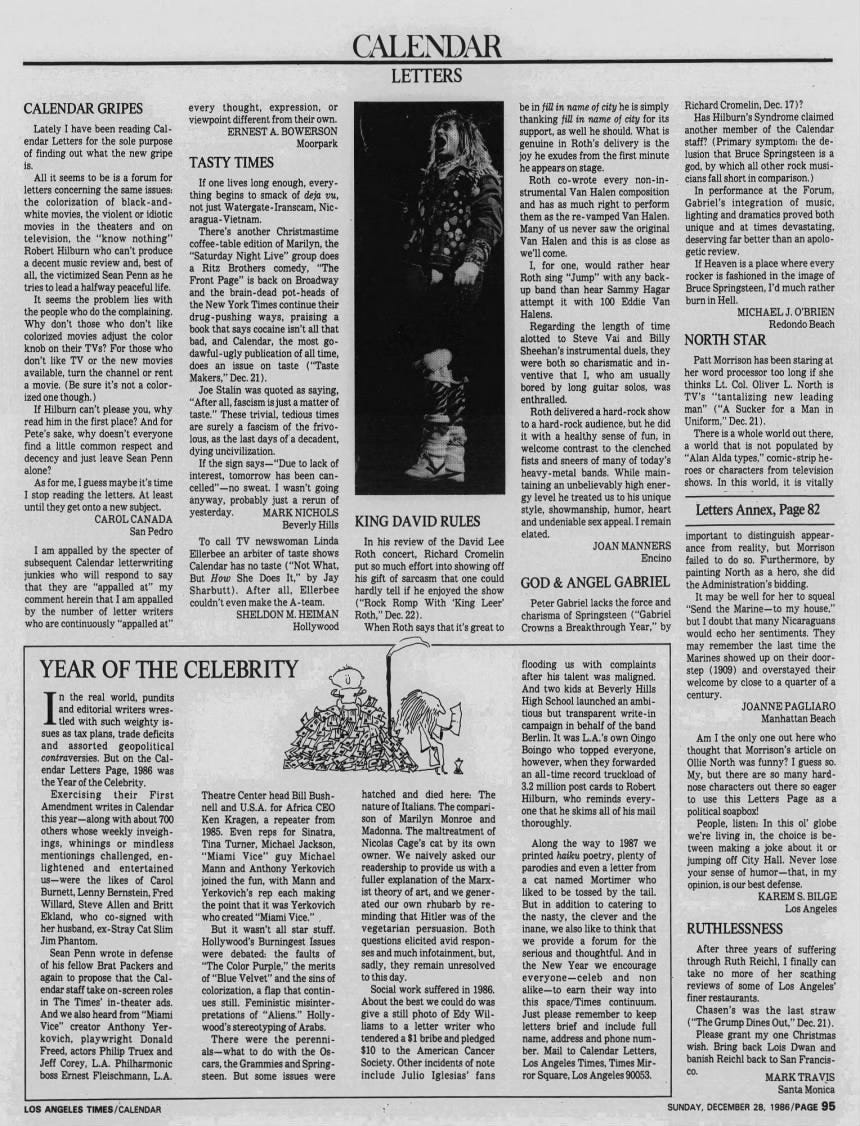
Aided and abetted by my colleague and friend, ace copy editor David Shear, I was supported and protected by the great Calendar editor, Irv Letofsky. I had one over-riding goal for the Letters Pages — to entertain, inform and arouse the readers of the Times’ huge and hugely popular section. All 1.1 million of them.
I’m proud to say David and I did exactly that each week — much to the ire of some brilliant critics who were not interested in pleasing ordinary readers or allowing them to criticize their exalted opinions in a public forum.
More info about our Letters Page crime spree is here.
***
As letters editor I broke as many rules of newspaper journalism as I could get away with.
Our common “crimes” included running letters upside down, obviously doctoring photos, soliciting readers’ letters, doing year-end wrap ups, brandishing our First Amendment absolutism, doing our own reporting and, most dangerously, giving celebrities like Cher and ordinary readers from Los Feliz a chance to talk back to the Calendar’s powerful critics.
We once ran three letters from the same guy the same day -- Marvin Leaf, a persistent anti-rock ‘n roll nut. When he sent us a letter from his deathbed, literally, we ran it immediately.
We built our little empire to please readers. We made fun of the Sunday LAT’s gigantic heft and let clever readers blast away — often unfairly -- at the critics and writers.
Giving the Letters Page a wise-ass but reader-friendly voice, I often inserted italic editor’s quips or facts after letters. But I never made fun of readers. I exalted their work and rewarded them with the best layouts we could give them.
When the Nuremberg Journalism Tribunals are held I will be brought up on charges for violating 231 dumb or arbitrary newspaper rules. I will defend myself by saying I was never an enemy of the reader. In a box I have nine years of rolled up Letters Page tear sheets to prove it.
In the 1980s the Sunday Calendar section was arguably one of the best and most influential newspaper entertainment sections of all time. Its Letters Page — and the Letter Annexes we created in the daily Calendars to carry the overflow during the week — was a small but important part of the reason.
Sadly, starting in 1990, after I left LA to return to my native Pittsburgh, Calendar was turned into a place that was as boring as the rest of the stuffy, slowly sinking super paper -- the Daily Titanic, as I now like to call it.
I also had a lot of fun — a dirty word in post-Watergate journalism — for which I have no regrets nor shame.
We had no rules.
Another randomly selected Sunday Calendar Letters Page fished from my bottomless archives …
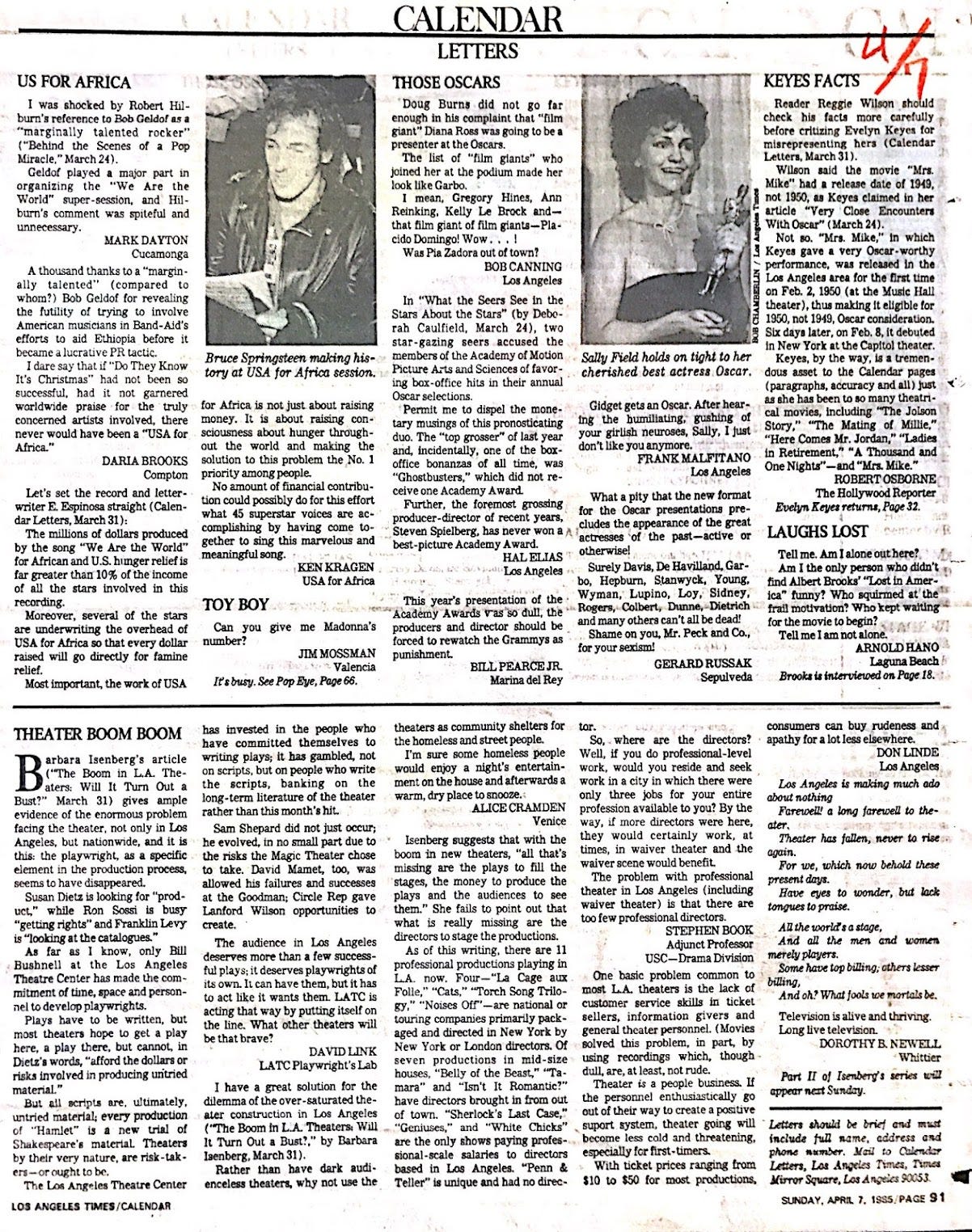
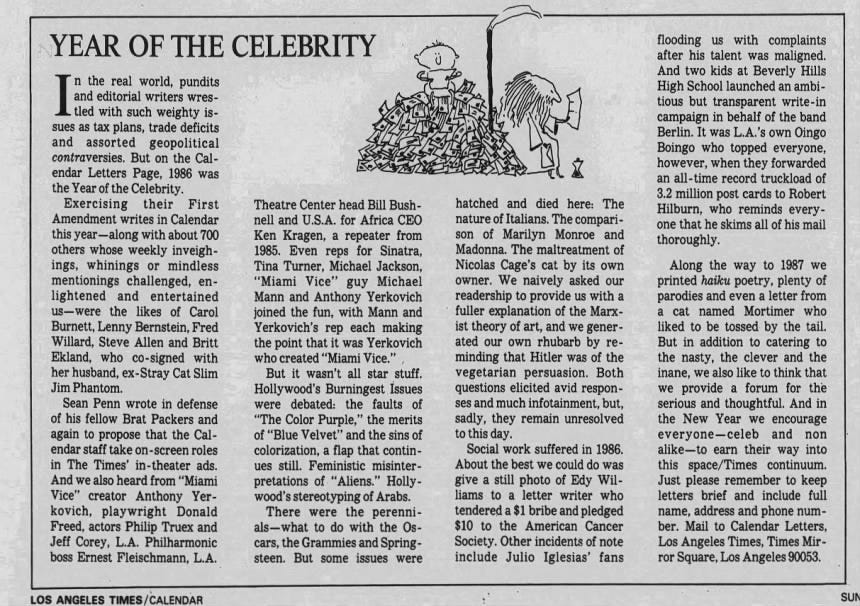
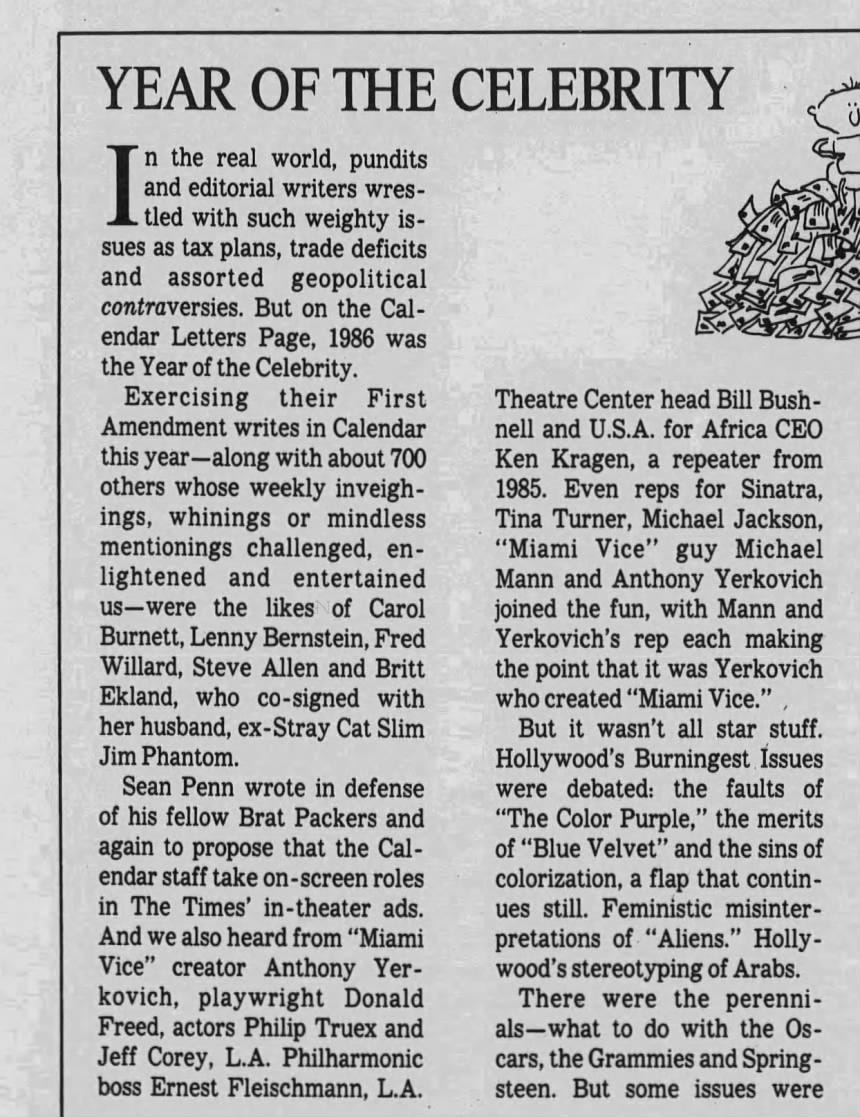
The end-of-1986-page reprinted below included my unsigned summary of what we dubbed the “Year of the Celebrity.”
It does not just prove that I was a mad man of letters who was using my friends and colleagues in the Calendar section as cannon fodder for the enjoyment of ordinary readers. It also proves that — without knowing it then — we were decades ahead of the Internet in democratizing journalism.
Just as the Internet would emancipate millions of readers by letting them freely and almost instantly express their First Amendment rights in online comment sections, the Calendar’s Letter Pages provided valuable space to hundreds of ordinary readers and celebrities who each week showed how smart, dumb, funny, nasty and perceptive they were in letters that — remember — had to be written, stamped and mailed days in advance.
As the 1986 wrap-up also shows, the Letters Page was a popular platform. Many inane and serious subjects were publicly aired, argued and hashed out by journalists, celebrities and readers whose voices — brilliant, silly or mean — would otherwise never have been heard. It was journalism by and for the people.
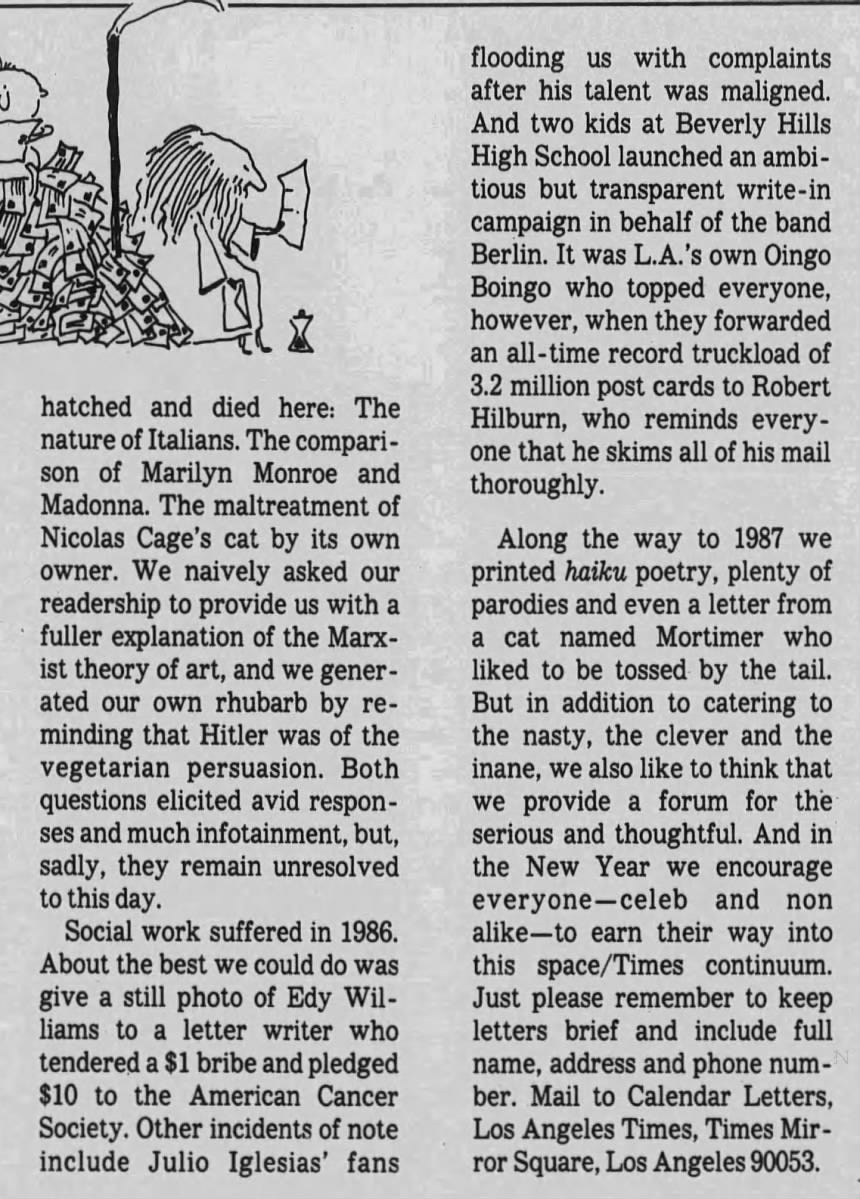
1986
Letters wrapup
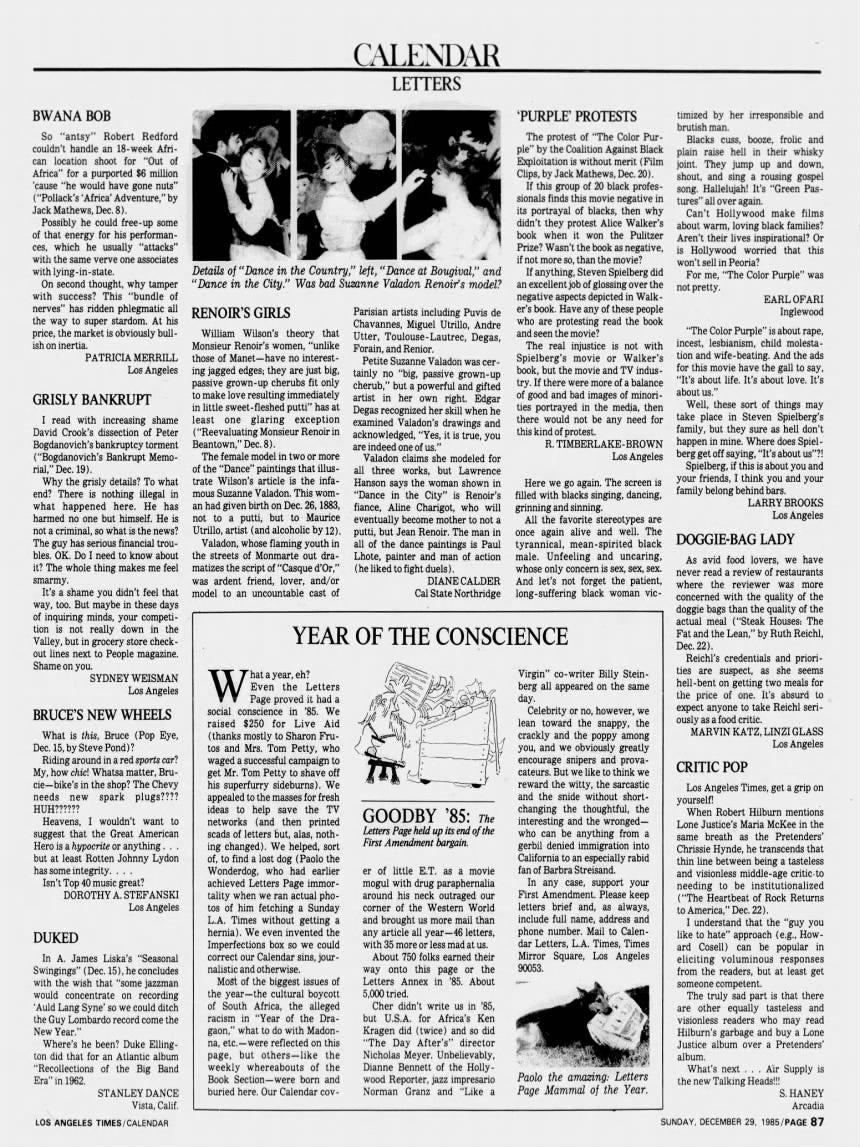
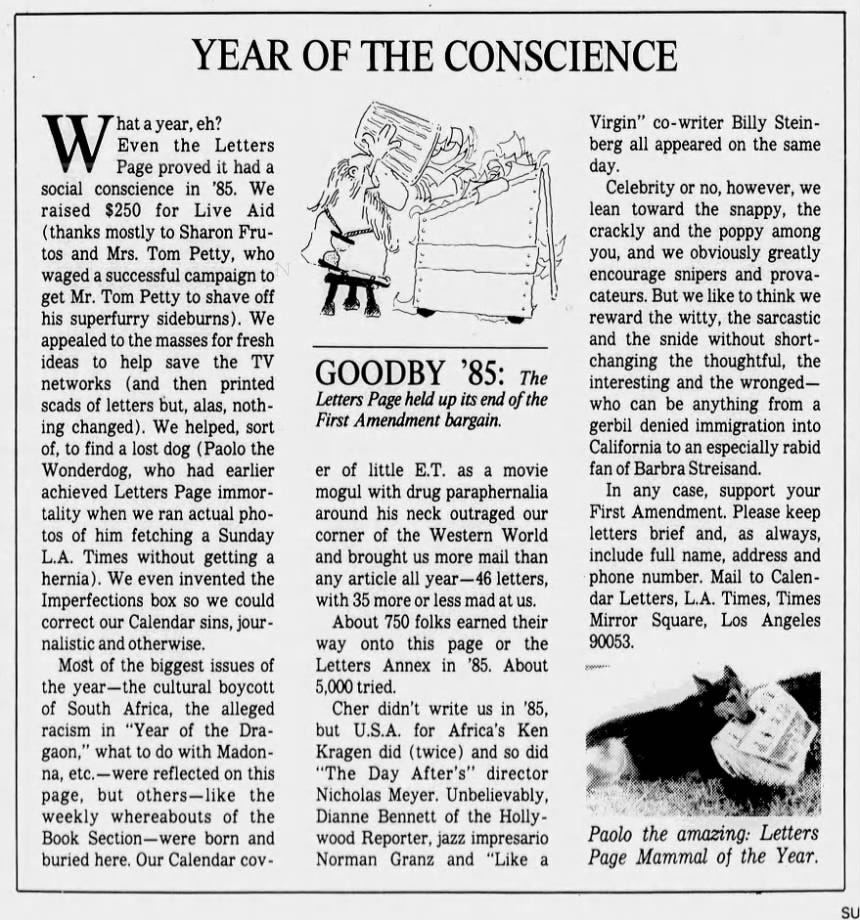
1985
Letters wrapup
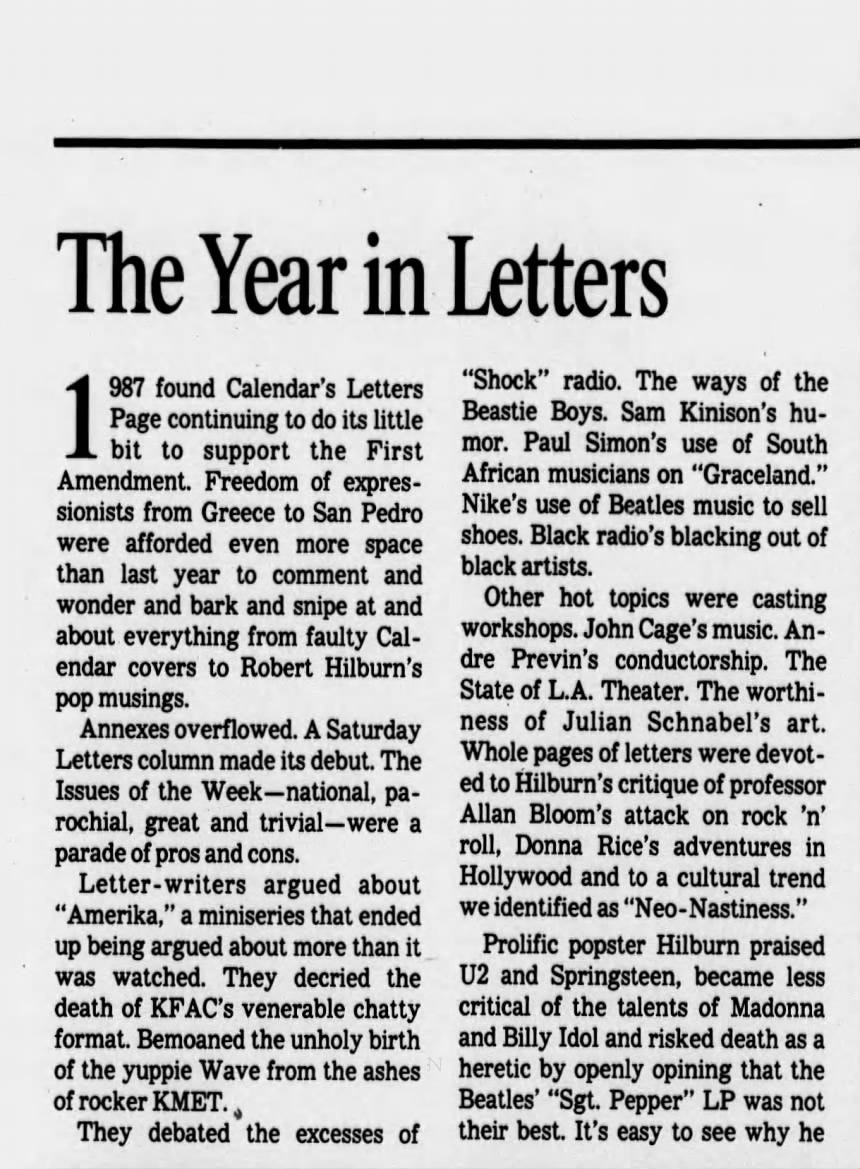
1987
Letters wrapup
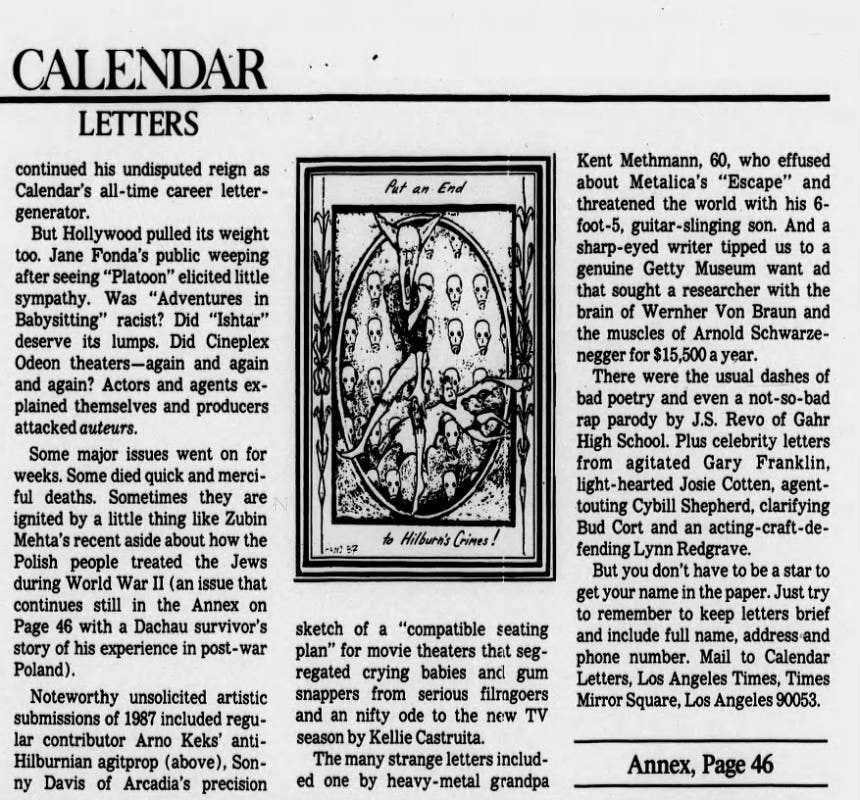
![The Year in Letters 987 found Calendar's Letters Page continuing to do its little bit to support the First Amendment. Freedom of expressionists from Greece to San Pedro were afforded even more space than last year to comment and wonder and bark and snipe at and about everything from faulty Calendar covers to Robert Hilburn's pop musings. Annexes overflowed. A Saturday Letters column made its debut. The Issues of the Week -national, parochial, great and trivial -were a parade of pros and cons. Letter- -writers argued about "Amerika," a miniseries that ended up being argued about more than it was watched. They decried the death of KFAC's venerable chatty format. Bemoaned the unholy birth of the yuppie Wave from the ashes of rocker KMET. They debated the excesses of Making Taste In "The Taste Makers" spread (Dec. 20) we have a quote from Hollywood's -the -hour, "Platoon's" director Oliver Stone, who proudly answers a question about his current "small pleasures" ("A Moralist in Movieland," by Paul Rosenfield): "Art. I'm enjoying collecting pieces by Julian Schnabel and Andy Warhol." Just inches away on the same page we have the brilliant art critic and historian Robert Hughes talking about art having to defend itself against mass-media fixation ("Art and the Alien Social Picture," by Lawrence Christon): "In America, TV -the wet-nurse of the cul-has been a disaster for the visual arts. The idea that painting has to demonstrate its up-to-dateness is willingly repeated by too many artists. The market wants stars. [Julian] Schnabel's work is to painting what Stallone's is to acting." And what Oliver Stone's is to directing??? One wonders what Hughes thought of "Platoon" or "Wall Street." Or, for that matter, what Stone thinks of Hughes' column in Time magazine or of his book about Australia, "The Fatal Shore." Unintentionally, perhaps, this juxtaposition leaves one to believe that one can, after all, account for taste. JOYCE GLASSER Los Angeles Rosenfield's article on Oliver Stone was headlined "A Moralist in Movieland." An odd title for a man whose scripts for "Scarface" and "Platoon" contain the greatest number of obscenities ever spoken on film and who, after deriving immense wealth because of "Platoon," next CALENDAR LETTERS "Shock" radio. The ways of the Beastie Boys. Sam Kinison's humor. Paul Simon's use of South African musicians on "Graceland." Nike's use of Beatles music to sell shoes. Black radio's blacking out of black artists. Other hot topics were casting workshops. John Cage's music. Andre Previn's conductorship. The State of L.A. Theater. The worthiness of Julian Schnabel's art. Whole pages of letters were devoted to Hilburn's critique of professor Allan Bloom's attack on rock 'n' roll, Donna Rice's adventures in Hollywood and to a cultural trend we identified as "NeoProlific popster Hilburn praised U2 and Springsteen, became less critical of the talents of Madonna and Billy Idol and risked death as a heretic by openly opining that the Beatles' "Sgt. Pepper" LP was not their best. It's easy to see why he attacks the unbridled capitalism of "Wall Street." It might have been better for Stone to have stayed in his own backyard -Hollywood, whose money- -grubbing dealmake their New York brethren appear pale by comparison. TONY THOMAS Burbank "Taste Makers" was tasteful and illuminating. I always knew that Madonna was continued his undisputed reign as Calendar's -time career lettergenerator. But Hollywood pulled its weight too. Jane Fonda's public weeping after seeing "Platoon" elicited little sympathy. Was "Adventures in Babysitting" racist? Did "Ishtar" deserve its lumps. Did Cineplex Odeon theaters--again and again and again? Actors and agents explained themselves and producers attacked auteurs. Some major issues went on for weeks. Some died quick and merciful deaths. Sometimes they are ignited by a little thing like Zubin Mehta's recent aside about how the Polish people treated the Jews during World War II (an issue that continues still in the Annex on Page 46 with a Dachau survivor's story of his experience in post- -war Poland). Noteworthy unsolicited artistic submissions of 1987 included regular contributor Arno Keks' antiHilburnian agitprop (above), Sonny Davis of Arcadia's precision no peroxide blonde dummy. Behind the video vixen facade is a real intellectual with influences ranging from David Mamet to Georgia O'Keeffe. Madonna, if it's over between you and Sean, then you and I can go to the library and get really intellectual together. We'll start out with Charles Bukowski and work our way up to Henry Miller. KEVIN LOCKWOOD San Diego The Hollywood (Gordon) Gekko ("Wall Street" greedster played by Michael Douglas) and the Turkish gecko. Truth in Geckos crenulation on what, to us, appear to be the smoothest of Please advise Sheila Benson surfaces (even glass). of a small, and by all means By bracing themselves trivial, error in her review of against these irregularities, the "Wall Street" ("'Wall Street' gecko is able to apply enough Lays an Egg," Dec. 11). frictional force to overcome the Contrary to popular opinion, effect of gravity on his tiny geckos do not have "suction little body. cups" on the ends of their toes. The public has a right to In truth, each gecko digit pos- know! sesses a complex pattern of hairs or bristles, which unerr- PETE BROMLEY ingly find irregularities and Costa Mesa Put an End to Hilburn's Crimes ! I 87 sketch of a "compatible seating plan" for movie theaters that segregated crying babies and gum snappers from serious filragoers and an nifty ode to the new TV season by Kellie Castruita. The many strange letters included one by heavy-metal grandpa Momma Throwing Kerry O'Neil's letter about "Throw Momma From the Train" (Calendar Letters, Dec. 20) was : a giant leap in movie criticism. Into the sewer. By his/her own admission, O'Neil admitted not having seen the film and was basing his/her judgment entirely on the title. Isn't open -mindedness wonderful? Misogynistic? Anti- -women? You have to be kidding. If anything, "Throw Momma" was almost anti-male. The two male leads are shown reacting impotently to their situations, seeing violence as their only escape route. Their hang -ups are the source of comedy, not any violence against women (of which there is actually none). The only totally sane, level- headed character in the movie was Billy Crystal's girlfriend. Anti- -women, indeed! PAUL McELLIGOTT Fullerton I was amazed, though pleased, that Calendar even printed O'Neil's letter. To counter the inevitable deluge of retorts from ego- wounded macho boys, I feel a few slightly more objective points could be made. It seems she has made some very accurate observations, and then missed the mark altogether. "Blatantly abusing" boys does indeed sell tickets- witness the success of Stallone et al., who gleefully annihilate hundreds of 'em each year to the tune of many million dollars. Women are by no means alone, though they are still getting the worst of it. Secondly, "Throw Momma From the Train" does not appear to be the realization of some misogynist SUNDAY, Kent Methmann, 60, who effused about Metalica's "Escape" and threatened the world with his 6- foot-5, guitar-slinging son. And a -eyed writer tipped us to a genuine Getty Museum want ad that sought a researcher with the brain of Wernher Von Braun and the muscles of Arnold Schwarzenegger for $15,500 a year. There were the usual dashes of bad poetry and even a -sorap parody by J.S. Revo of Gahr High School. Plus celebrity letters from agitated Gary Franklin, light- -hearted Josie Cotten, agenttouting Cybill Shepherd, clarifying Bud Cort and an acting-craft-defending Lynn Redgrave. But you don't have to be a star to get your name in the paper. Just try to remember to keep letters brief and include full name, address and phone number. Mail to Calendar Letters, Los Angeles Times, Times Mirror Square, Los Angeles 90053. Annex, Page 46 plot by the big- -time industry idiots (something that cannot be said for "Fatal Attraction" and 90% of contemporary American movies). Apparently, someone with a warped sense of humor thought one day, "What is the most horrible, repulsive, shocking subject I can think of, and how can I make it funny?" That's nothing -we underground cartoonists have been doing it for decades. WOLF FAIRLIGHT Cerritos I must say that now it should be obvious to everyone where Danny DeVito got the inspiration for the character "Momma." DAVID DRURY Sierra Madre Reservations The article on restaurant reservations ("No Wait at the Inn," by Ruth Reichl, Dec. 20) was interesting, but it begs the obvious question: How many of these restaurants actually honor their reservations? The article is correct in finding that making a reservation is rarely a problem -the restaurants are eager to lure you in because they know that once you're there you're stuck. You can't go anywhere else at the last minute without reservations and if you try, you have to pay yet another valet to ransom your car and have to start waiting all over again. In short, getting a reservation at a popular restaurant is only half the battle; the battle will only be won when restaurants learn to honor their promises. SUSAN L. GANS Los Angeles DECEMBER 27, 1987/PAGE 103](https://substackcdn.com/image/fetch/$s_!iBmz!,f_auto,q_auto:good,fl_progressive:steep/https%3A%2F%2Fsubstack-post-media.s3.amazonaws.com%2Fpublic%2Fimages%2F9281deb5-7af6-461d-8529-26879b9abb34_860x1188.jpeg "The Year in Letters 987 found Calendar's Letters Page continuing to do its little bit to support the First Amendment. Freedom of expressionists from Greece to San Pedro were afforded even more space than last year to comment and wonder and bark and snipe at and about everything from faulty Calendar covers to Robert Hilburn's pop musings. Annexes overflowed. A Saturday Letters column made its debut. The Issues of the Week -national, parochial, great and trivial -were a parade of pros and cons. Letter- -writers argued about \"Amerika,\" a miniseries that ended up being argued about more than it was watched. They decried the death of KFAC's venerable chatty format. Bemoaned the unholy birth of the yuppie Wave from the ashes of rocker KMET. They debated the excesses of Making Taste In \"The Taste Makers\" spread (Dec. 20) we have a quote from Hollywood's -the -hour, \"Platoon's\" director Oliver Stone, who proudly answers a question about his current \"small pleasures\" (\"A Moralist in Movieland,\" by Paul Rosenfield): \"Art. I'm enjoying collecting pieces by Julian Schnabel and Andy Warhol.\" Just inches away on the same page we have the brilliant art critic and historian Robert Hughes talking about art having to defend itself against mass-media fixation (\"Art and the Alien Social Picture,\" by Lawrence Christon): \"In America, TV -the wet-nurse of the cul-has been a disaster for the visual arts. The idea that painting has to demonstrate its up-to-dateness is willingly repeated by too many artists. The market wants stars. [Julian] Schnabel's work is to painting what Stallone's is to acting.\" And what Oliver Stone's is to directing??? One wonders what Hughes thought of \"Platoon\" or \"Wall Street.\" Or, for that matter, what Stone thinks of Hughes' column in Time magazine or of his book about Australia, \"The Fatal Shore.\" Unintentionally, perhaps, this juxtaposition leaves one to believe that one can, after all, account for taste. JOYCE GLASSER Los Angeles Rosenfield's article on Oliver Stone was headlined \"A Moralist in Movieland.\" An odd title for a man whose scripts for \"Scarface\" and \"Platoon\" contain the greatest number of obscenities ever spoken on film and who, after deriving immense wealth because of \"Platoon,\" next CALENDAR LETTERS \"Shock\" radio. The ways of the Beastie Boys. Sam Kinison's humor. Paul Simon's use of South African musicians on \"Graceland.\" Nike's use of Beatles music to sell shoes. Black radio's blacking out of black artists. Other hot topics were casting workshops. John Cage's music. Andre Previn's conductorship. The State of L.A. Theater. The worthiness of Julian Schnabel's art. Whole pages of letters were devoted to Hilburn's critique of professor Allan Bloom's attack on rock 'n' roll, Donna Rice's adventures in Hollywood and to a cultural trend we identified as \"NeoProlific popster Hilburn praised U2 and Springsteen, became less critical of the talents of Madonna and Billy Idol and risked death as a heretic by openly opining that the Beatles' \"Sgt. Pepper\" LP was not their best. It's easy to see why he attacks the unbridled capitalism of \"Wall Street.\" It might have been better for Stone to have stayed in his own backyard -Hollywood, whose money- -grubbing dealmake their New York brethren appear pale by comparison. TONY THOMAS Burbank \"Taste Makers\" was tasteful and illuminating. I always knew that Madonna was continued his undisputed reign as Calendar's -time career lettergenerator. But Hollywood pulled its weight too. Jane Fonda's public weeping after seeing \"Platoon\" elicited little sympathy. Was \"Adventures in Babysitting\" racist? Did \"Ishtar\" deserve its lumps. Did Cineplex Odeon theaters--again and again and again? Actors and agents explained themselves and producers attacked auteurs. Some major issues went on for weeks. Some died quick and merciful deaths. Sometimes they are ignited by a little thing like Zubin Mehta's recent aside about how the Polish people treated the Jews during World War II (an issue that continues still in the Annex on Page 46 with a Dachau survivor's story of his experience in post- -war Poland). Noteworthy unsolicited artistic submissions of 1987 included regular contributor Arno Keks' antiHilburnian agitprop (above), Sonny Davis of Arcadia's precision no peroxide blonde dummy. Behind the video vixen facade is a real intellectual with influences ranging from David Mamet to Georgia O'Keeffe. Madonna, if it's over between you and Sean, then you and I can go to the library and get really intellectual together. We'll start out with Charles Bukowski and work our way up to Henry Miller. KEVIN LOCKWOOD San Diego The Hollywood (Gordon) Gekko (\"Wall Street\" greedster played by Michael Douglas) and the Turkish gecko. Truth in Geckos crenulation on what, to us, appear to be the smoothest of Please advise Sheila Benson surfaces (even glass). of a small, and by all means By bracing themselves trivial, error in her review of against these irregularities, the \"Wall Street\" (\"'Wall Street' gecko is able to apply enough Lays an Egg,\" Dec. 11). frictional force to overcome the Contrary to popular opinion, effect of gravity on his tiny geckos do not have \"suction little body. cups\" on the ends of their toes. The public has a right to In truth, each gecko digit pos- know! sesses a complex pattern of hairs or bristles, which unerr- PETE BROMLEY ingly find irregularities and Costa Mesa Put an End to Hilburn's Crimes ! I 87 sketch of a \"compatible seating plan\" for movie theaters that segregated crying babies and gum snappers from serious filragoers and an nifty ode to the new TV season by Kellie Castruita. The many strange letters included one by heavy-metal grandpa Momma Throwing Kerry O'Neil's letter about \"Throw Momma From the Train\" (Calendar Letters, Dec. 20) was : a giant leap in movie criticism. Into the sewer. By his/her own admission, O'Neil admitted not having seen the film and was basing his/her judgment entirely on the title. Isn't open -mindedness wonderful? Misogynistic? Anti- -women? You have to be kidding. If anything, \"Throw Momma\" was almost anti-male. The two male leads are shown reacting impotently to their situations, seeing violence as their only escape route. Their hang -ups are the source of comedy, not any violence against women (of which there is actually none). The only totally sane, level- headed character in the movie was Billy Crystal's girlfriend. Anti- -women, indeed! PAUL McELLIGOTT Fullerton I was amazed, though pleased, that Calendar even printed O'Neil's letter. To counter the inevitable deluge of retorts from ego- wounded macho boys, I feel a few slightly more objective points could be made. It seems she has made some very accurate observations, and then missed the mark altogether. \"Blatantly abusing\" boys does indeed sell tickets- witness the success of Stallone et al., who gleefully annihilate hundreds of 'em each year to the tune of many million dollars. Women are by no means alone, though they are still getting the worst of it. Secondly, \"Throw Momma From the Train\" does not appear to be the realization of some misogynist SUNDAY, Kent Methmann, 60, who effused about Metalica's \"Escape\" and threatened the world with his 6- foot-5, guitar-slinging son. And a -eyed writer tipped us to a genuine Getty Museum want ad that sought a researcher with the brain of Wernher Von Braun and the muscles of Arnold Schwarzenegger for $15,500 a year. There were the usual dashes of bad poetry and even a -sorap parody by J.S. Revo of Gahr High School. Plus celebrity letters from agitated Gary Franklin, light- -hearted Josie Cotten, agenttouting Cybill Shepherd, clarifying Bud Cort and an acting-craft-defending Lynn Redgrave. But you don't have to be a star to get your name in the paper. Just try to remember to keep letters brief and include full name, address and phone number. Mail to Calendar Letters, Los Angeles Times, Times Mirror Square, Los Angeles 90053. Annex, Page 46 plot by the big- -time industry idiots (something that cannot be said for \"Fatal Attraction\" and 90% of contemporary American movies). Apparently, someone with a warped sense of humor thought one day, \"What is the most horrible, repulsive, shocking subject I can think of, and how can I make it funny?\" That's nothing -we underground cartoonists have been doing it for decades. WOLF FAIRLIGHT Cerritos I must say that now it should be obvious to everyone where Danny DeVito got the inspiration for the character \"Momma.\" DAVID DRURY Sierra Madre Reservations The article on restaurant reservations (\"No Wait at the Inn,\" by Ruth Reichl, Dec. 20) was interesting, but it begs the obvious question: How many of these restaurants actually honor their reservations? The article is correct in finding that making a reservation is rarely a problem -the restaurants are eager to lure you in because they know that once you're there you're stuck. You can't go anywhere else at the last minute without reservations and if you try, you have to pay yet another valet to ransom your car and have to start waiting all over again. In short, getting a reservation at a popular restaurant is only half the battle; the battle will only be won when restaurants learn to honor their promises. SUSAN L. GANS Los Angeles DECEMBER 27, 1987/PAGE 103")
Imperfections
Not only did we builders of the Calendar Letters Empire democratize the commenting process, we invented modern fact-checking and a level of customer service that Amazon’s Mr. Bezos clearly plagiarized.
Traditionally, the “For the Record” alerts, or corrections and clarifications, were usually small, usually buried somewhere at the bottom of a page and usually (deliberately) incomprehensible.
Written by lawyers or copy editors whose first rule was “Never repeat the mistake,” they were token admissions of error that were so garbled and legalistic they were largely useless to any readers not intimately familiar with the original story or the mistake.
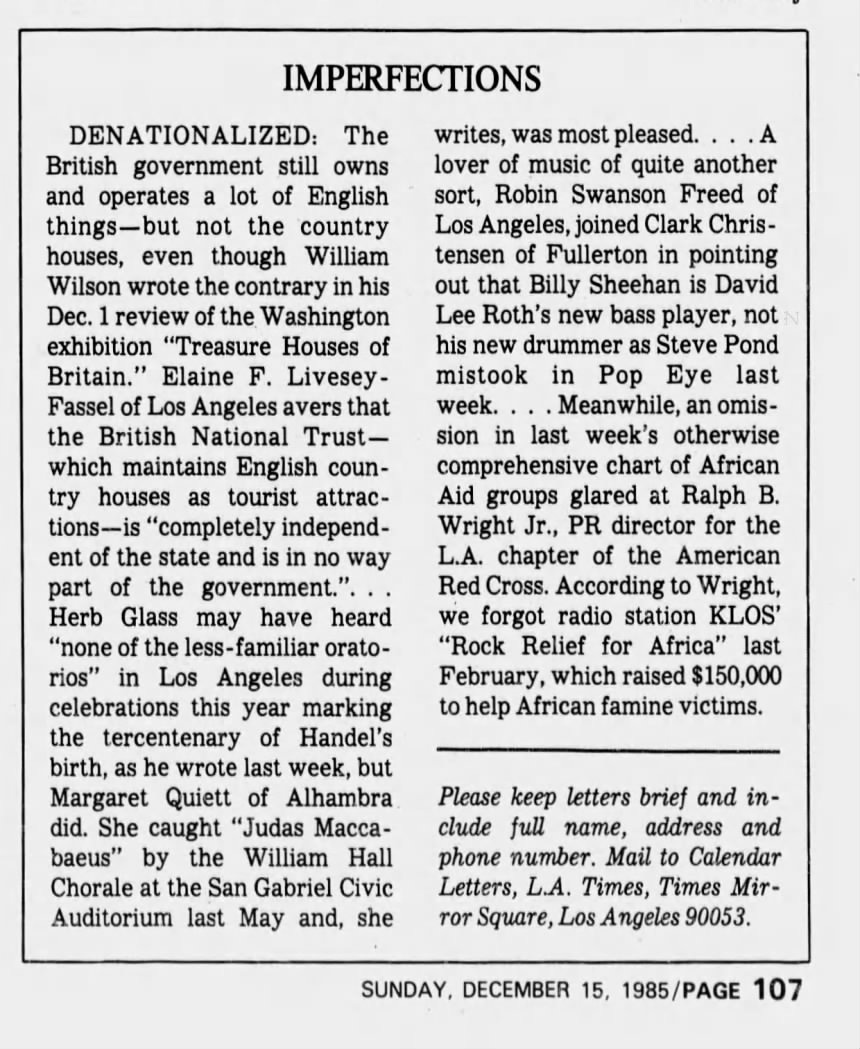
To correct this 400-year-old journalism process of fact-fixing, in 1985 we created the “Imperfections Box.” Initially, it was innocently designed to call attention to the few big and little errors and gaffes made in the daily and Sunday Calendars.
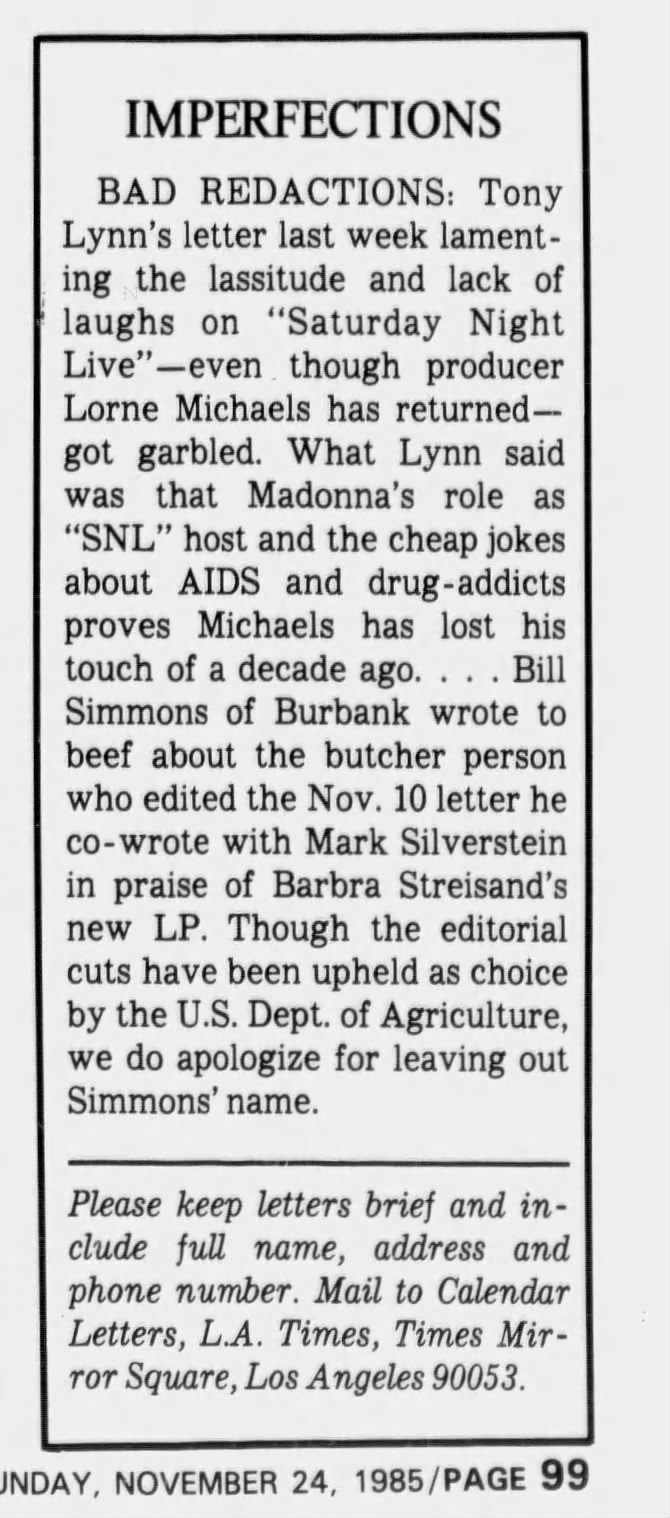
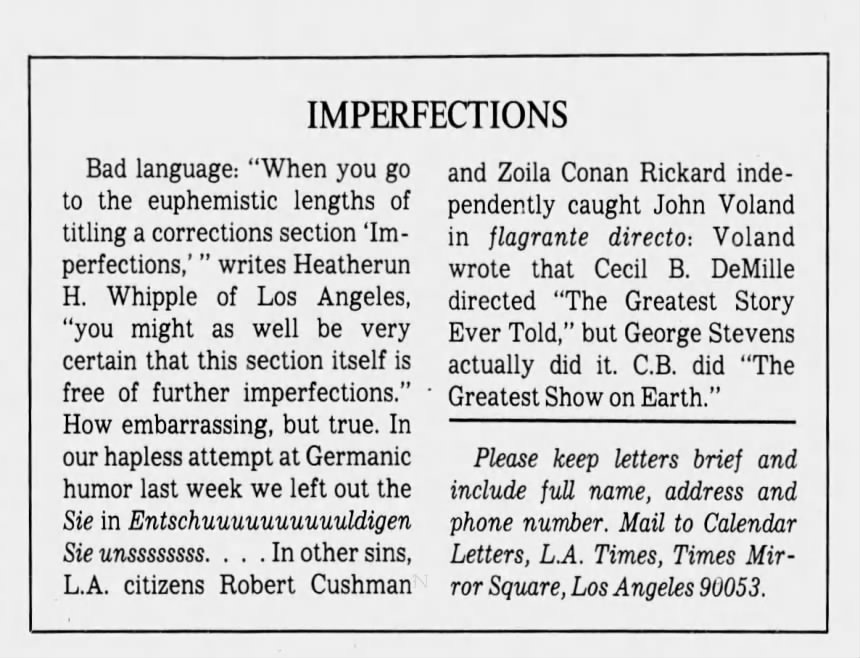
But it evolved — or devolved, depending on whether how much money you had wasted attending a journalism graduate school. We not only set the factual record straight, we had some fun with our mistakes — which was either a mortal sin or a serious crime, depending on how religious you were about upholding the sacred tenets of serious journalism.
Here’s a straightforward Imperfection Box:
Here’s a sillier one.
And here:
Google and AI are born
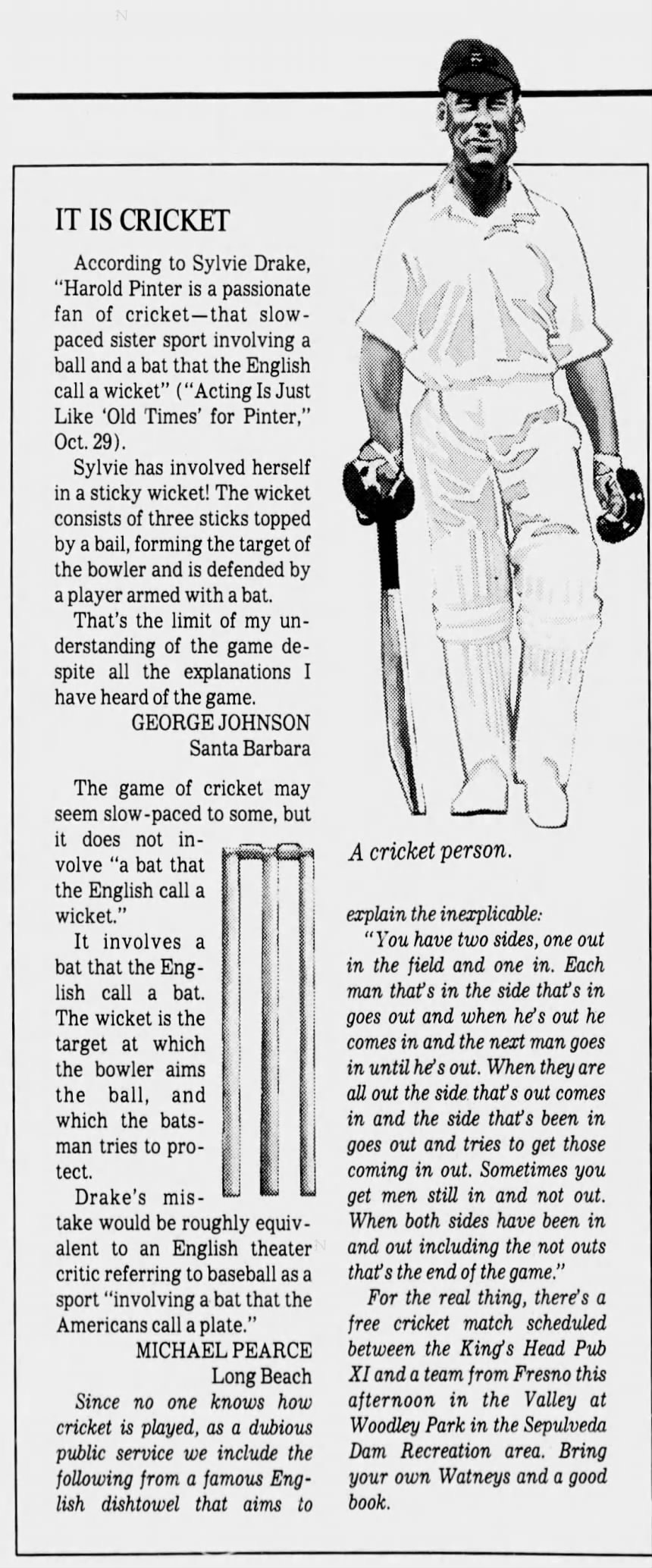
Oh, yeah. We also semi-invented Google search and ChatGPT and Grok decades before they were born, as this Nov. 1985 fun we had with cricket proved.
We openly exploited our million readers.
We realized they were a valuable and nearly infinite resource who were willing to be baited and eager to join the fun. They learned their letters would be considered no matter what they said or whether they were typed or written in crayon.
Decades before the digital age destroyed print media’s dictatorial control over the number and flavor of reader comments, we — not Al Gore — invented interactive media.
We democratized the letter-writing process. We proudly pushed the First Amendment “writes” of our readers.
We tried to create a page of letters with an irreverent, teen-age spirit of trouble-making that wasn’t afraid to break the stuffy and rigid rules of proper journalism or mercilessly criticize the Times reporters and critics — a rogue page that readers could count on to inform, entertain, please or annoy them. It worked.
The Times, like most papers during the last Golden Age of Print, didn’t do much marketing research. But I heard once that the Letters Pages were the most-read thing in the Sunday paper except for the pen-and-ink drawings of Al Hirschfeld, the legendary caricaturist whose iconic pen-and-ink drawings of theater and Hollywood stars occasionally appeared.
Young Matt Welch of Long Beach, who would grow up to be an editor at the times and the editor of Reason magazine, once told me he and his teen-age friends looked forward to the Letters Page each week.
It made me proud. That endorsement would have made the Big Editors on the Serious Side of the Los Angeles Times Building ill, but for nine years they paid little attention to the sins against good journalism being committed on the second-to-last page of the Sunday Calendar.
Thank you. I haven’t thought of Marvin Leaf OR Irv Letofsky in decades.