Outing John Steinbeck's lies
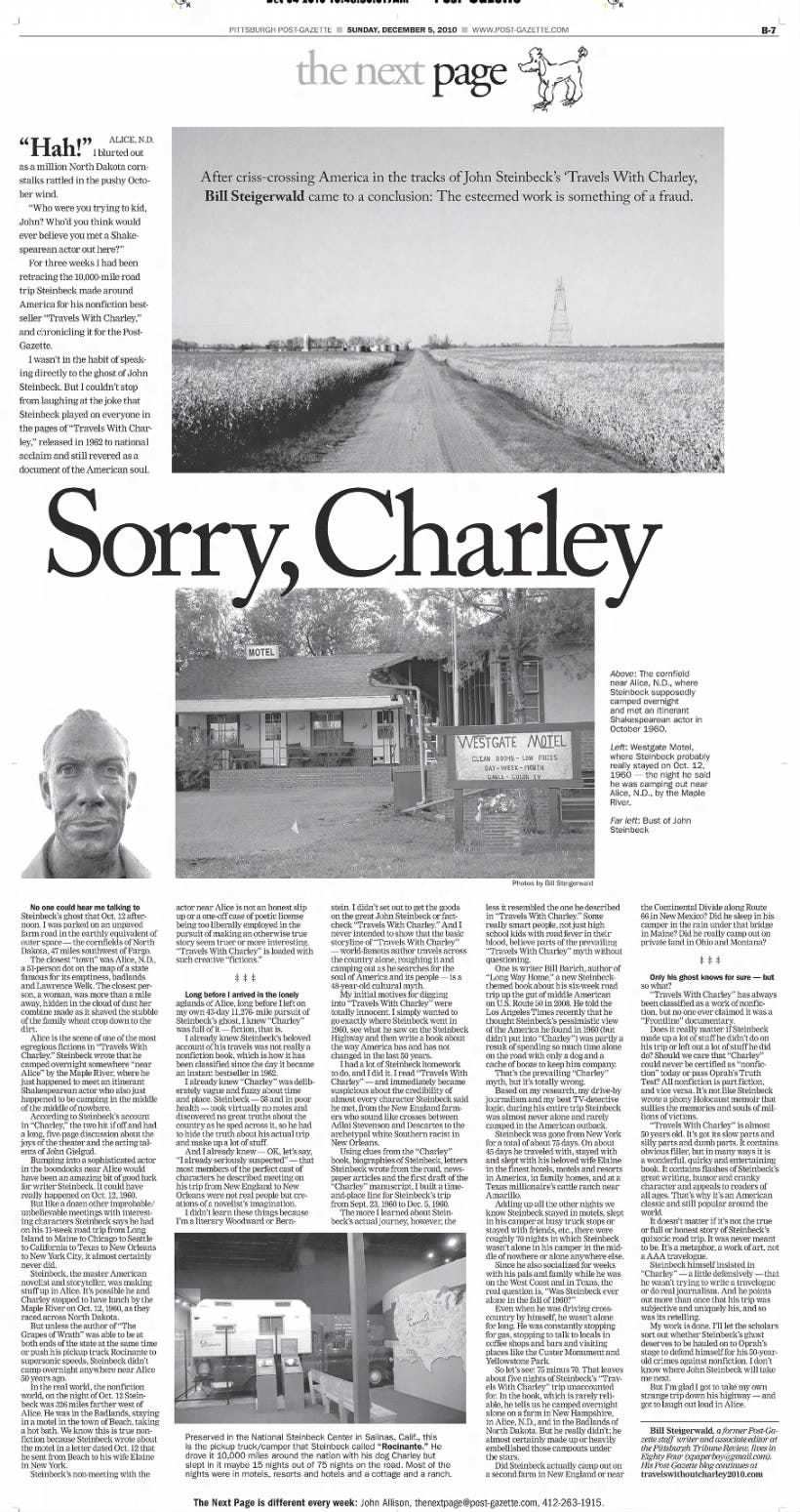
In 2012 the New York Post published this article about how my research in libraries and my drive-by journalism changed the way 'Travels with Charley' will be read forever.

Still Sorry, Charley
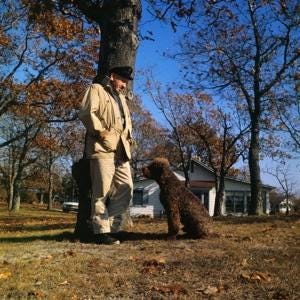
In 2012, after half a century of masquerading as a work of nonfiction, and after almost 1.5 million copies sold, “Travels With Charley’s publisher confessed the truth — on its 50th birthday.
A lot has happened in Steinbeck World since I caused my trouble. Here’s a link to some of my later items. And here is a link to the 2012 New York Post story, which is reprinted below.
Sorry, Charley
Nw York Post
Nov. 25, 2012
Penguin Group, which owns the rights to John Steinbeck’s works, didn’t say “Travels With Charley” was “a literary fraud.”
That’s what I so impertinently charged in the pages of the Pittsburgh Post-Gazette in 2010, two years ago, after I found major discrepancies between what Steinbeck wrote in his classic road book and the actual trip he took around the US in the fall of 1960.
But Penguin quietly comes clean in the latest edition of “Charley,” which was published Oct. 2 to celebrate the book’s 50th birthday. Inserting a disclaimer into the book’s introduction, the company warned future readers of Steinbeck’s last major work that it’s so heavily fictionalized it shouldn’t be taken literally.
For the past two years, I’ve been causing trouble for many of the “Travels With Charley” fans, scholars and publishers who live in Steinbeck World.
It started innocently. In the fall 2010, as part of a book project to show how much America has changed in the past 50 years, I set out to faithfully retrace the 10,000-mile road trip Steinbeck made in his pickup truck-camper hybrid. (I drove 11,276 miles in 43 days).
While doing research for my road trip — which included reading the original handwritten manuscript of “Charley” at the Morgan Library & Museum — I stumbled onto an uncomfortable truth.
Though the book had always been marketed, sold, reviewed and taught as a true account of Steinbeck’s journey, I soon realized “Charley” was mostly fiction — a parade of invented wooden characters and made up events, plus a few lies and deliberate distortions thrown in by Steinbeck and his sly editors at the Viking Press to create the myth that the great author traveled alone, roughed it and spent a lot of time studying and thinking about America and its people.
In fact, Steinbeck did virtually none of the above. He traveled with his wife on 43 of the 77 days he was gone from New York. He mostly stayed at luxury hotels, resorts and with friends and family. And he rarely, if ever, slept in his camper alone and under the stars in the American outback.
For instance, Steinbeck describes in great detail two overnight campouts in North Dakota, one in the ocean of cornfields near Fargo and one the next night in the Badlands 300 miles west.
But on the nights he was supposed to be camping under the stars, he was actually staying at a motel in Beach, ND, enjoying a hot bath. At least that’s what he wrote in a letter to his wife from Beach on Oct. 12, 1960.
Scholars mostly dismissed my discoveries, saying it didn’t matter because Steinbeck told “greater truths” with his fiction. And I was cursed by Steinbeck groupies around the world for spoiling their fun with my fetish for facts.
It was hard to persuade them I didn’t hate Steinbeck or “Charley,” which, despite its serious lapses in the truth department, and its glaring literary flaws, flashes with his great nature writing, wisdom and humor.
Penguin’s subtle confession ends the argument in my favor. It was slipped into the book’s lengthy introduction by Jay Parini, the Middlebury College English professor and Steinbeck biographer who first wrote it in 1997.
Along with smaller caveats, Parini issued this warning:
“Indeed, it would be a mistake to take this travelogue too literally, as Steinbeck was at heart a novelist, and he added countless touches — changing the sequence of events, elaborating on scenes, inventing dialogue — that one associates more with fiction than nonfiction. (A mild controversy erupted, in the spring of 2011, when a former reporter for the Pittsburgh Post-Gazette did some fact-checking and noticed that Steinbeck’s itinerary didn’t exactly fit that described in the book, and that some of the people he supposedly interviewed, such as an actor at a campsite in North Dakota, never existed.) It should be kept in mind, when reading this travelogue, that Steinbeck took liberties with the facts, inventing freely when it served his purposes, using everything in the arsenal of the novelist to make this book a readable, vivid narrative.”
Naturally, after all my mad journalism on and off the road I was not pleased to see that my name was not mentioned. At least after 50 years the truth had triumphed.
Yet Parini and other academics soft pedal Steinbeck’s fictionalizing — i.e., fibbing — saying it doesn’t matter because he was telling greater truths. Of course, that “truth-telling” begs some questions.
At what point do all the fictions in “Charley” — or memoirs like “A Million Little Pieces” or Greg Mortenson’s “Three Cups of Tea” — discredit the book’s value as an accurate and honest account of reality? And at what point do all those phony quotes from dozens of Steinbeck’s made-up characters in a nonfiction book add up to literary fraud?
What Steinbeck did obviously was not as serious or calculatedly self-serving as Mortenson, who used his lies to raise tens of millions of dollars. But 2 1/2 generations of trusting readers of all ages were duped by Steinbeck. No writer could get away with it today — and no one in the past, no matter how talented, should, either.
And here is a link to the Dec. 5, 2010 Post-Gazette article exposing Steinbeck as a fictionalizer — and that took the New York Times six months to write an article about.