
Kevin Phillips, political guru
In his 'American Theocracy' Phillips said the evil axis of religion, oil and debt -- plus a failing war in the Middle East -- were problems for the Republican Party of 2006. They still are.

Kevin Price Phillips (November 30, 1940 – October 9, 2023) was an American writer and commentator on politics, economics, and history. He emerged as a Republican Party strategist who helped devise its Southern Strategy in the 1960s. Phillips became disaffected with the party by the 1990s, subsequently leaving it to become an independent and staunch critic of the Republicans. He was a regular contributor to the Los Angeles Times, Harper's Magazine, and National Public Radio, and was a political analyst on PBS's NOW with Bill Moyers. — Wikipedia
Q&A: Kevin Phillips
April 20, 2006
Unfortunately for the Bush Dynasty, and for the troubled Republican Party, political analyst and long-lapsed Republican Kevin Phillips has written another book. His 1969 book, The Emerging Republican Majority, was said to be one of the most important and controversial books in modern American politics.
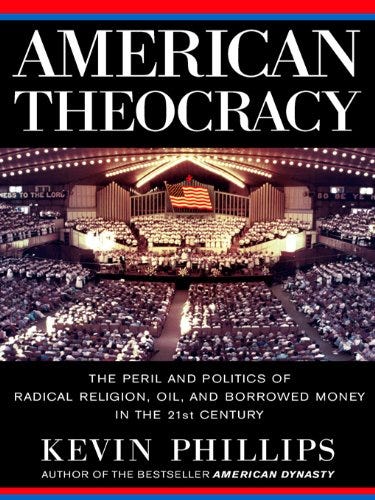
This one, “American Theocracy,” is, as its subtitle says, about “The Peril and Politics of Radical Religion, Oil, and Borrowed Money in the 21st Century.”
More succinctly, as a well-spun ad for Phillips’ 12th book puts it, “American Theocracy” is about how “After 40 years of dominating the presidency, the national coalition that elected George W. Bush has become arrogant and inept -- pandering to the Religious Right, blundering in the Middle East to serve the oil industry, and recklessly building a false prosperity on borrowed money.”
I talked to Phillips on April 13, 2006 by phone from New York City.
Kevin Phillips
Q: You say the last two elections have transformed the Republican Party into “the first religious party in U.S. history.” How is this religious influence in politics and government hurting the country?
A: You start right at the top with the sense that as the world situation is focusing more and more on the Middle East, to have a political party becoming in many ways semi-captive to the portion of the Religious Right which is concerned about the Book of Revelations, Armageddon, the End of Times -- the whole Tim Lahaye cycle -- causes major problems for foreign policy and tends to suck us into the Middle East, where the Bible is seen as unfolding.
On the home front, the increasing religiosity of the Republican Party creates problems in terms of the conflict between faith and science. You see this on reproductive drug policy. You see it on stem-cell research, where for example in Missouri the Republican Party is dividing over this; it’s got its church wing and its business wing.
You see it in the Terri Schiavo situation, where George W. and his brother, Jeb, were so busy trying to pander to the Religious Right that they intervened in things that most people thought were a family responsibility.
Q: You say oil defines and distorts American foreign policy. Oil plus religion -- that’s a bad mix.
A: Actually it’s more of a mix than people think. The United States went into Iraq with a very scrambled set of explanations. There was no willingness to acknowledge that oil even played a role, which is a joke, because clearly it was a major, major consideration.
I would think for (Dick) Cheney it was probably the dominant one. They wouldn’t talk about that, partly because I think the Republican coalition has such a huge religious constituency that you have to bear in mind their viewpoint. You couldn’t talk about oil. You had to talk about good versus evil and all that business about bringing liberty to the Middle East.
I can’t imagine that any serious people at the top of the government get up in the morning and the first meeting is about democracy in the Middle East. It’s not what it’s all about.
Q: This concern with oil is nothing new. And it’s also bipartisan. Gore and everybody have oil influences, which isn’t surprising either. Oil is so important to everything. It’s hard not to be worried or interested in it.
A: I would be a lot more sympathetic with the Bush administration if they had said they had decided to go into Iraq substantially because of oil. It would have made sense. George Bush Sr. and Jimmy Baker back in 1990 made no bones about energy.
But this time I’m not certain there was great agreement within the administration. Some of them were clearly thinking about the neoconservative rationale, which was a whole Israeli-related defense structure in the Middle East. Others were probably mixing oil in there and pretending they weren’t.
And still others may have had a sense of trying to get a base to replace Saudi Arabia, but basically I think it was oil.
Q: Is your book an indictment of the Republican Party, of the nature of the political system, of the Bushes, what?
A: Well, it’s all of those, and an indictment up front, too, of the total ineffectiveness of the Democratic opposition. So I think it’s probably a fairly broad indictment.
It’s an indictment of the Bushes, because the Bushes have been involved for over a quarter of a century, in which they played a very major role with oil, with money, with the debt and credit industry, and with radical religion.
Ronald Reagan didn’t have to pander to the Religious Right, but George H.W. did and then his son took over in spades.
In terms of all the three ingredients, you have a major Bush impact on the Republican Party because beginning in 1980, there was only one election to date where there was not a Bush as either the vice presidential or presidential nominee on the Republican ticket. They’ve re-shaped the party.
Q: You dedicated your book to the Republicans.
A: Yes, to the Republicans who’ve either publicly or privately opposed these people.
Q: How would you define a good or sensible or honest Republican these days?
A: It’s hard to do, because they’ve been slow to learn the lesson that I think was there to be learned three or four years ago. They were just too happy to jump on the bandwagon.
You’ve clearly got now a bunch of the movement conservatives totally contemptuous of Bush. They may rally around him for some reason, but they are privately contemptuous.
So I would say at this point that you have between 20 and 30 percent of Republican self-identifiers who either are not answering the president’s job-approval question or disapproving of the way he is doing his job. You have an interesting mix there.
You’ve got people who were pro-McCain in 2000. People who are effectively no longer Republicans. You’ve got people who are supply-siders and staunch movement conservatives. So it’s an interesting package. I couldn’t give you a simple definition for it.
Q: You’ve painted a pretty grim picture. Is it going to get worse or better?
A: I would think that there’s going to be more of a crisis before there is a solution. For example, in the paper this morning it’s clear that a number of generals now are beginning to revolt, even semi-publicly, against (Donald) Rumsfeld.
That goes hand-in-hand with a partial revolt in the Republican Party. The price of oil -- you have prices going crazy. I don’t know how high interest rates are going to go.
I think we’ve got a president, frankly, who is one of the least prepared for major issues in the history of the United States. The notion that he can discuss a number of these things seriously, to me, is far-fetched.
If you talk to him about the currency problem of the OPEC countries leaving the dollar price for pricing in euros, I think he’d just stun people with his lack of awareness. The same would be true of Middle East geopolitics. I think we’re paying a huge price there.
Thoughtful, and troubling if not terrifying. Thanks.