

David McAlister Barry (born 3 July 1947) wrote a nationally syndicated humor column for the Miami Herald from 1983 until he retired in 2005. He has written numerous books of humor and parody and kids books and when I talked to him he had taken up blogging. His web site.
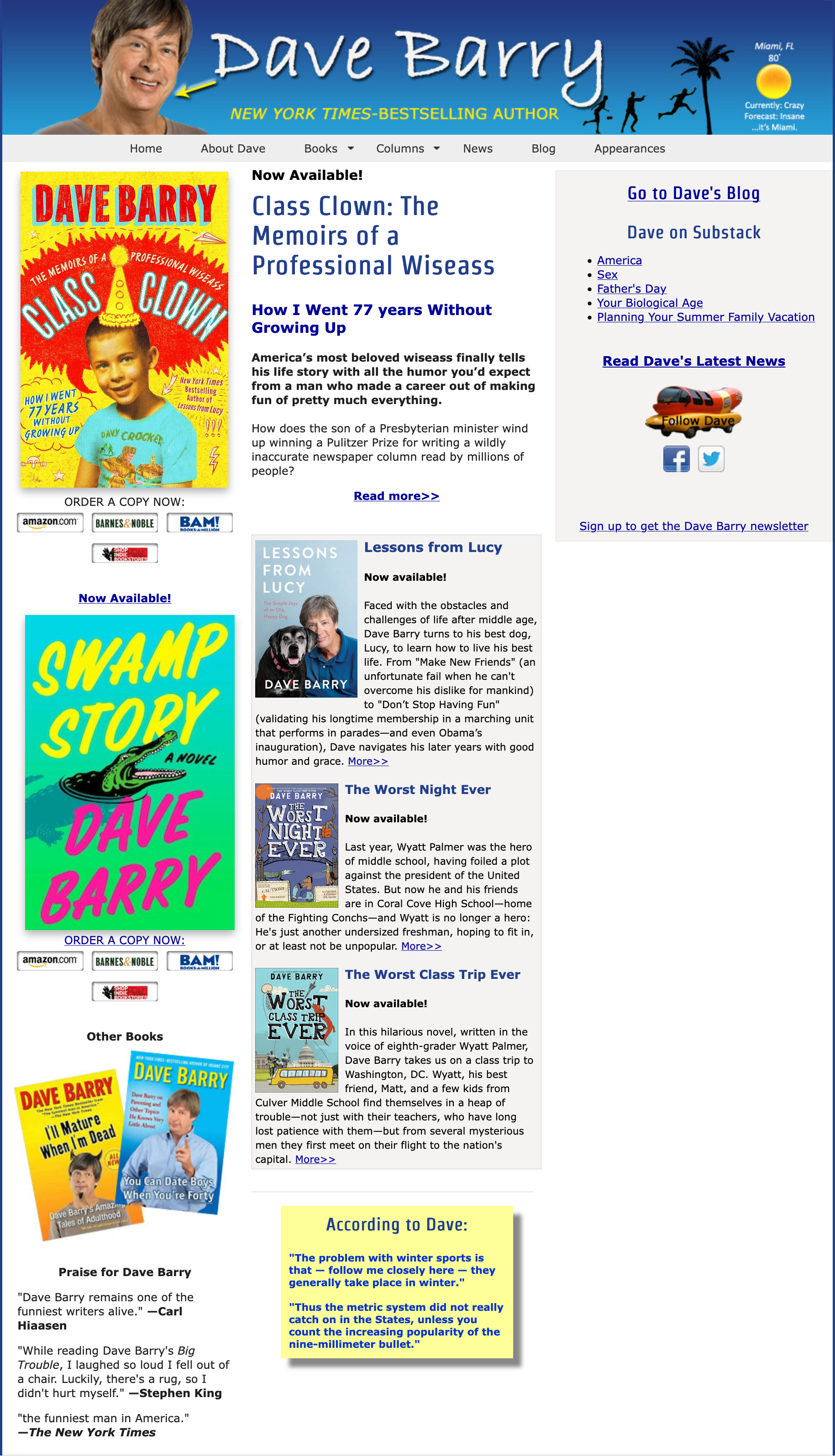
The best of his breed, the man the New York Times claimed was the funniest man in America, Barry won a Pulitzer Prize for Commentary (1988).
Personal note: When I was a history major and English minor at Villanova U. in Philly in the late 1960s, he was an English major at nearby Haverford College, where I’d go to mixers because the bands were much better. As far as I know we never met.
Dave Barry
Q: Do you approve of the new Pope?
A: Well, nobody’s asked me. First of all, I totally approve of the new pope, if only because now the man, finally, will no longer be called, Ratzinger. If I were named Ratzinger, I would make my life’s ambition to become pope or something, so I could be called something else. I’m very happy for Pope Benedict that whatever happens now, he no longer has to be called Ratzinger.
Q: Do you miss being able to make fun of the big news events in a column?
A: Not really. I do it some on the internet. But I wasn’t really ever that much of an on-the-top-of-the-news columnist anyway. Most of my columns ran weeks if not months after the events I was talking about occurred.
Q: What the biggest plus or minus about writing a blog – is it more work?
A: No. No. The standards are lower (laughs), because you can just throw something up there. What I tend to do a lot is just link to something that somebody sent in and make a quick comment about it. But then the commenters take over. Every now and then I’ll write something that’s closer to a real column take on something, although usually much shorter. The upside is that it’s kind of fun and very immediate. The downside is that people get so impatient. They want you to blog all the time. You have to remind yourself that they are not really paying you to do this (laughs. You don’t have to write something for your blog e-v-e-r-y couple of hours.
Q: Who was your typical reader?
A: I had a sense of it from reading my mail. It was a pretty bizarre cross-section. There were a lot of 12 and 13 year old boys. And then there were a lot of old ladies. People with spare time. I’d get lawyers and
Q: Are you at all sorry you got into newspaper journalism?
A: No. I am very happy I got into it. It was probably the best career choice I ever made. I do think it would be very different if I were trying to get into it now. I don’t think newspaper journalism really resembles what it did 35 years ago when I was getting started in it. It’s in a way too bad.
And I am amazed people still want to do it, because the hurdles are a lot higher and the negatives are a lot greater than they used to be. But I’ve had a wonderful time in journalism. I never had any useful skills at all. I still love newspaper people. My wife is a newspaper people. Most of our friends are newspaper people. I’m still a newspaper guy in my heart.
Q: You were not a “trained” journalist?
A: No. I was an English major. I did write columns for the Haverford College newspaper, but they were just newspaper columns. My real journalism training came in the summers, when I was an intern at Congressional Quarterly in Washington, which was very very serious journalism. So I kind of felt that I had a clue. When I got out of college I went to work at a newspaper in West Chester, Pa., and that was really the greatest crash course imaginable in journalism. It was perfect, really. Just the perfect place to learn that craft.
I learned what it was like to cover a fire and cover a municipal meeting and write an obituary and talk to an angry reader and write a column and write a feature – all that stuff at once. I’d say a couple of months of working at a small daily paper equals 58 years at Columbia Journalism School.
Q: You seem happier and more good-natured than the typical journalist.
A: Yeah, I’ve been happy in it, but I’ve been lucky too. I’ve always been a happy, upbeat person, with a certain cynical view of the world. I don’t expect too much of the world, and so I’m never all that disappointed by it. I’ve always been happy about my job and what I do. But who wouldn’t be happy if you get to be paid to be a humor columnist – to make stuff up and sit at home in your underwear and write a column. What’s wrong with that job? Anybody who really serious complains about being a columnist should just go get a real job (laughs).
Q: What should the average reader know about journalism that would help put what they read into proper perspective?
A: We kind of ask a lot of journalists. Lately, everyone is down on the media. I think it’s important to remember that even though, yes, the media have biases – anybody who doesn’t think that is kind of foolish. But the truth is, we’re trying very hard.
The journalists I know – every last one of them – the last thing that person would want to do is be inaccurate or misleading. It’s still an amazing thing they do, journalists. They just can’t do it perfectly. Because of the Internet, it’s just so easy now to get on the Internet and find discrepancies and jump all over it.
But if you take basically what the news media do every day, it’s pretty amazing how much they produce, without which you wouldn’t know anything that’s going on in the world.
Even the bloggers – and I’m a blogger and I like blogging – sometimes they seem to forget that almost all their information – the beginning and ending point for almost everything — is what they saw in the newspapers. Somebody has to go out there and do the boring, drudgery of getting the information in the first place, which is not NEARLY not as much fun work as ridiculing everything, but still, it’s pretty important work.
Q: Have you ever let your political biases creep into you columns?
A: Yeah, I suppose so. I’m a libertarian. But that’s kind of an easy stance to be if you’re a humor columnist because you’re tending to make fun of the government and the powerful.
I don’t think I’ve ever proselytized. I’ve never wanted to. I’ve always thought, there are plenty of people writing columns that are telling you what you should think. When people read my column, I assume they’re reading it to be amused.
As I’ve said before, if I can think of a joke that actually directly contradicts what I believe, but it’s funny, I’ll go with the joke, just ‘cause I want to amuse my readers more than preach. That’s always been my goal.
That isn’t to say that if I find some unbelievable stupid activity, like, for example, the Department of Agriculture, that I won’t ridicule it, and it won’t feel really good to me to ridicule it, because it’s exactly in line with what I think ought to be done with it. But that’s usually not what I’m trying to do.
Q: When you say libertarian, are we talking Cato Institute libertarian?
A: No. I’m sort of a soft-core libertarian in that my compass is generally pointing away from “Let’s let the government do this” or “Let’s let the government take care of this.”
Does it matter to me that it’s Democrats who think we need more elaborate programs that involve shifting money from one group to another group, or it’s Republicans saying we need to take a harder look at what kinds of things people are watching on cable TV?
We need government oversight. Neither one of those things strikes me as a good idea. Not because I don’t think the people are well-intentioned, just because I don’t think they have a clue what I need.
Q: You’re permanently running for president, right? What would you do first if you were elected?
A: The first thing I would do would be to take at least six months off. I always thought that one of the greatest advantages of being president is that you could take vacations whenever the hell you want.
I would be a very vacation-oriented president. When I wasn’t taking vacationing, I would be doing a lot of motorcading. I feel that the president’s main job is to get out there and motorcade around, screw up traffic in every city. Just, you know, show that he’s got that motorcade if I he needs. I think that’s probably the most visible and important thing the president can do.
Q: Since your talk Wednesday is a sell out …
A: That tells me there’s just not enough going on in Pittsburgh. Too many people with just too much spare time, if my talk is already a sell out.
Q: Can you tell the poor folks who can’t make it to your talk what they are going to miss?
A: I would say that the people who are not coming have made a wise choice, because I am not going to say anything useful to the people who are coming. In fact, I may actually lower their IQs. People may come out of that talk unable to remember where they parked their cars, or how to get home.
I’ll be kind of the opposite of the Dali Lama. People will not come away with any great sense of fulfillment. They’ll come out much emptier than when they went in.
Great interview
Can you share a link to his blog?