

The 150th anniversary of the Battle of the Little Bighorn (often called "Custer's Last Stand") will be commemorated in Crow Agency, Montana, this weekend (June 25–28).
As AI wokefully, but accurately describes it, the commemoration is an event that 'brings together the National Park Service and Native communities to observe the 1876 victory of Lakota, Northern Cheyenne, and Arapaho warriors.'
Whatever it's called, what happened on that grassy hilltop in 1876 was an American tragedy.
In 2010 I retraced the 10,000-mile road trip around the USA John Steinbeck took in 1960 and turned into his multi-flawed and dishonest 'nonfiction' book 'Travels with Charley.’
Steinbeck stopped at the Custer Battlefield in 1960 as he and his dog Charley raced across Montana on his way to Seattle, so so stopped there exactly fifty years later.
I’ll always be glad I did.
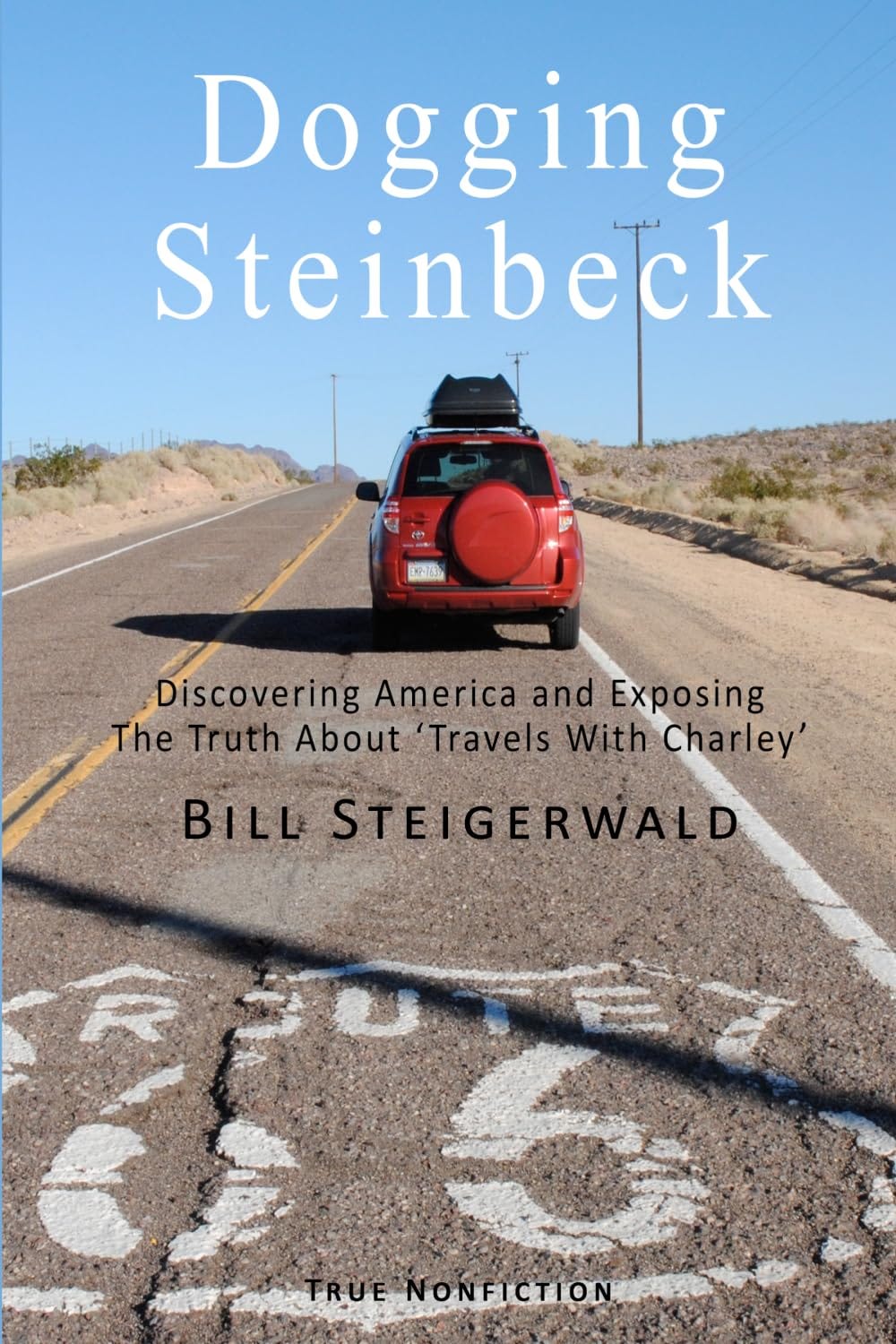
This is the chapter from my book 'Dogging Steinbeck' -- a work of 'true nonfiction' I like to call it -- that describes my first visit to a haunting, powerful and bloody place everyone should experience once in their life.
Brave Ghosts
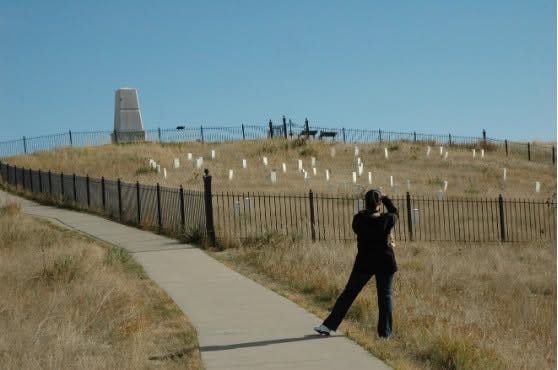
The Little Bighorn Battlefield National Monument, as the site of Custer’s Last Stand is officially called, was a lovely place for a massacre. In every direction the rolling brown land was big and the blue sky even bigger. The only sound was the stiff steady wind that rippled the dry grass and starched the American flag flying high above the Custer Memorial Cemetery.
Everything – the parking lot, the visitors center and the cemetery and its ring of protective trees – looked up at Last Stand Hill, where a stone monument, a low black iron fence and 41 white gravestones stuck out of the thin grass. Talk about ghosts. If they exist anywhere, they exist on the silent windswept hilltop where Gen. Armstrong Custer and 40 of his men died on June 25, 1876.
Getting myself to the site of Custer’s Last Stand had been a pleasant cruise through tall cornfields and short hayfields, but for the local wildlife one stretch of State Route 47 was a killing field. In a minute I saw a dead coyote, a dead skunk, two dead raccoons and a dead something else. Whatever hit them – including one of the trucks overloaded with lumpy sugar beets like the ones they left sprinkled on the road – was probably doing 75 like me. Not far from breakfast in Hardin I passed one of the favorite ambiguous road signs of my trip – “Slow Down When Dusty.”
On a bright sunny Friday morning only 10 cars were in the Custer Battlefield parking lot. Steinbeck would have been annoyed to see the “No dogs off leash” sign. When he and Charley took their side trip to “pay our respects to General Custer and Sitting Bull," as he put it, they both were able to wander indiscriminately over the battlefield. Park ranger/historian Gerald Jasmer told me that except for some landscaping and the stone or gravel pathways laid out through the grassy slopes, no dramatic changes had been made to the site since Steinbeck’s time. The most significant difference since 1960 is how much more we know about what really went on during the battle itself.
Fifty years ago, most of what Steinbeck and everyone else in the country knew about Custer’s Last Stand came from Hollywood, where history and facts go to be tortured on the bloody altar of bad drama. But Jasmer said a lucky break occurred in 1983 when a wildfire burned off the battlefield’s grass and gave forensic archeologists access to thousands of artifacts – mainly spent cartridges and human remains – strewn over the slopes during the fighting. The legend of a heroic last stand by Custer and his soldiers, built up first by 19th century newspapers Back East and then Hollywood, was spoiled by facts and cold science. A more realistic, more likely scenario is that in the face of certain death the horse soldiers scattered and died in a state of panic and fear.
Steinbeck would have heard the white-man’s politically incorrect version of what happened at the Little Big Horn. Visitors today get a more fair-and-balanced account of a military "engagement" – now there's a great euphemism – in which 260 men from the U.S. Army's 7th Calvary and 100 Lakota-Cheyenne warriors slaughtered each other in an unnecessary battle in an unimportant place. There’s also an Indian Memorial in memory of the tribes who died “defending their way of life at the Battle of the Little Big Horn.”
In a letter to his wife Steinbeck called Custer a “dumb bastard,” which he was. But in Travels with Charley he writes that when he went to the battlefield site he "removed my hat in memory of brave men." If that’s what he did, it was a classy thing to do at a beautiful, almost spiritual monument to unimaginable human bravery, savagery and stupidity.
Hmm, it seems you are not a Custer fan. I'm a Betsy Custer fan. She believed in and loved her husband till her last breath.
Boots and Saddles (1885) — A memoir recounting her life with Custer on the frontier, offering a personal and affectionate portrait of him Nebraska Press.
Following the Guidon (1890) — Another account of her experiences with Custer, emphasizing his leadership and personal qualities.
Tenting on the Plains (1893) — A book describing life in the field with Custer, including his campaigns in Kansas and Texas.
Custer made a grave error, but no one can say he wasn't a remarkable figure in history. Betsy Custer's unrelenting quest to prove her husband a gallant hero has largely gone unnoticed. In their case, I feel behind that once great man, George A. Custer, was a great woman, his wife Betsy.
In reference to Steinbeck, I read all is books in my 20s and found Travels with Charlie to be a favorite. Always willing to listen to another point of view, I look forward to reading the "untruths" you claim.
I visited in 1998, early October, and the only person there. It was peaceful. And also very easy to see how 100 Lakota-Cheyenne warriors could have stayed hidden as they approached. Hollywood smoothed out the undulating ground.